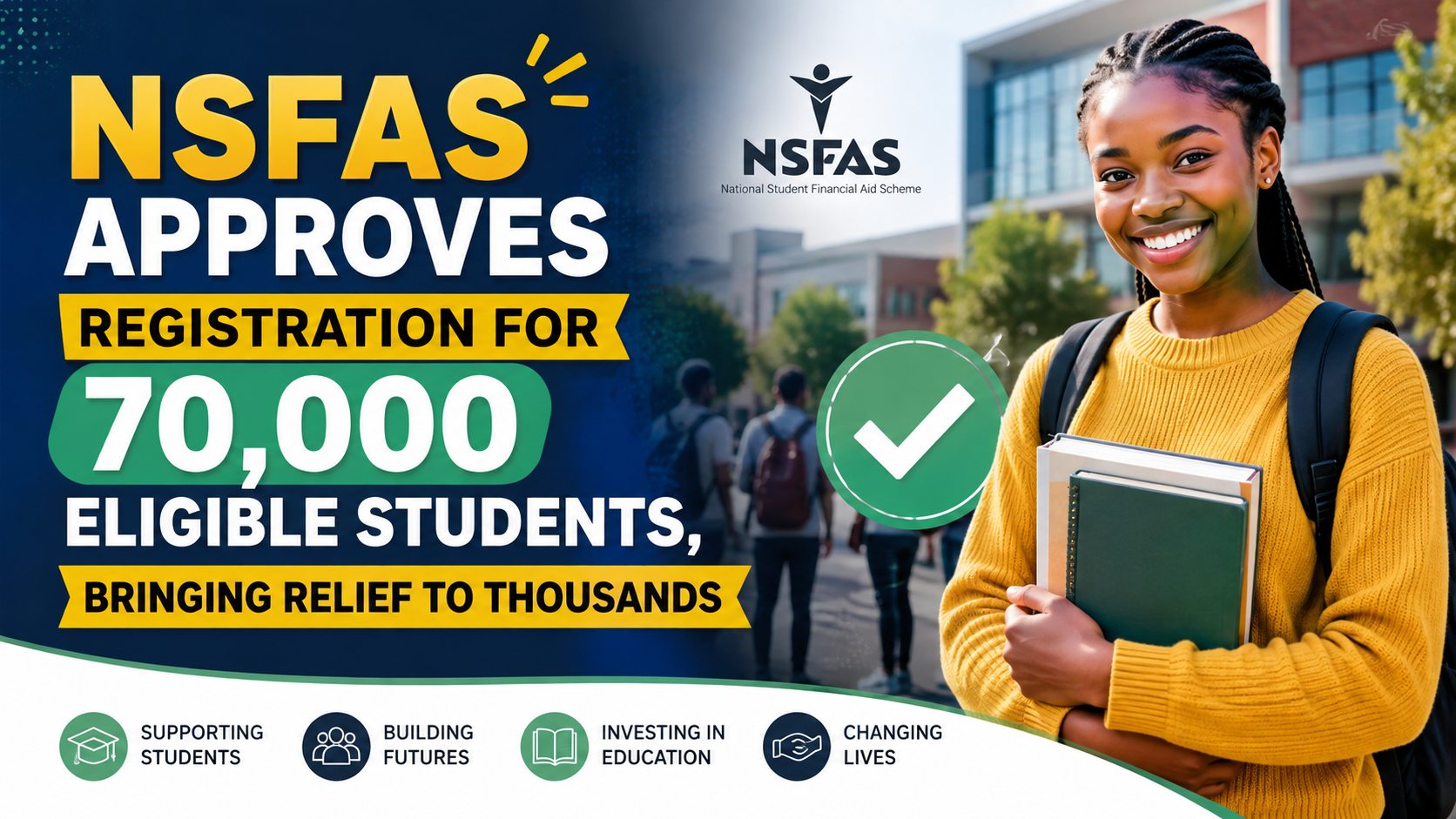
Approves Registration for 70,000 Eligible Students. Thousands of South African students have received welcome news after the National Student Financial Aid Scheme (NSFAS) confirmed that more than 70,000 eligible students will now be allowed to register for their studies. The decision follows the approval of funding for students who had been waiting for months to receive confirmation of their financial aid.
The announcement marks a significant step toward improving access to higher education and resolving long-standing registration delays that affected many deserving students across the country.
NSFAS Gives Registration Approval to Eligible Students
NSFAS Administrator Professor Hlengani Mathebula confirmed that approximately 72,000 students studying at Universities of Technology and the University of South Africa (UNISA) have now been cleared to register.
Many of these students were unable to complete their registration because they were waiting for NSFAS to confirm whether their funding applications had been approved. The uncertainty caused stress for thousands of students who feared they would miss the opportunity to continue their studies during the second semester.
With the latest decision, universities can proceed with registration while NSFAS processes the approved funding.


Who Qualifies for Registration?
According to NSFAS, the approval applies to students who meet the existing funding requirements under government policy. These include students who fall into categories such as:
- Students requiring top-up funding
- Second registration students
- Eligible students at Universities of Technology
- Eligible UNISA students
- Students who meet all NSFAS funding criteria

The administrator explained that these students have always qualified for financial support, but operational challenges delayed the final approval process.
Decision Based on Government Policy
Professor Mathebula stated that the decision was made after carefully reviewing government funding policies and the eligibility status of affected students.
He emphasized that students who satisfy NSFAS requirements should not be prevented from continuing their education due to administrative delays. By approving their registration, NSFAS aims to ensure that deserving students are not disadvantaged while the organisation continues improving its systems.
This decision is expected to reduce uncertainty and help institutions continue academic activities without further disruption.
NSFAS Stabilisation Plan Introduced
The registration announcement follows the submission of a comprehensive NSFAS Stabilisation Plan to Higher Education and Training Minister Buti Manamela.
The plan focuses on improving the efficiency, governance and overall performance of NSFAS after several years of operational difficulties.
Key objectives of the stabilisation plan include:
- Improving service delivery
- Speeding up funding decisions
- Strengthening financial management
- Enhancing communication with students
- Reducing registration delays
- Building stronger relationships with universities
The plan aims to restore confidence in the student financial aid system while ensuring funding reaches eligible students on time.
Extensive Consultation With Stakeholders
Professor Mathebula explained that during his first three months as NSFAS Administrator, he met with more than 20 stakeholder groups to understand the challenges facing the scheme.
These consultations included:
- University management
- Student Representative Councils (SRCs)
- Student organisations
- Labour unions
- Higher education officials
- Other organisations involved in student funding
The discussions helped identify operational problems and develop practical solutions to improve NSFAS services.
Relief for Thousands of Students
The latest approval comes as a major relief for students who were uncertain about their academic future.
Many students had already received admission offers from their institutions but could not finalise registration because their funding status remained unresolved.
Without registration, students risked missing classes, examinations and important academic deadlines.
By approving funding for eligible students, NSFAS has removed one of the biggest obstacles preventing thousands from continuing their education.
Improving Student Financial Aid
The announcement also reflects NSFAS’s commitment to improving its operations following criticism over delayed payments, registration issues and communication challenges experienced in previous academic years.
The organisation has indicated that it will continue working with universities and government departments to create a more efficient funding system that benefits students across South Africa.
Future improvements are expected to include:
- Faster application processing
- Better communication with applicants
- Improved online systems
- Quicker payment processing
- Stronger governance and oversight
- Greater operational transparency
What Students Should Do Next
Students who believe they qualify under the approved categories should monitor communication from both NSFAS and their respective institutions.
Universities will begin processing registrations for approved students, while NSFAS continues updating funding records.
Students should also ensure that:
- Their personal details are accurate.
- Required supporting documents have been submitted.
- They regularly check their NSFAS accounts.
- They respond promptly to any requests for additional information.
Following these steps can help prevent further delays in the registration process.
Conclusion
The approval allowing more than 70,000 eligible students to register represents an important milestone for NSFAS and South Africa’s higher education sector. By clearing funding for students who already meet eligibility requirements, the scheme has provided much-needed certainty to thousands who were waiting to continue their studies.
While operational improvements are still underway, the latest decision demonstrates a stronger commitment to ensuring that financial challenges do not prevent deserving students from accessing higher education. As the NSFAS Stabilisation Plan is implemented, students, universities and stakeholders will be hoping for a more reliable, transparent and efficient funding system in the years ahead.