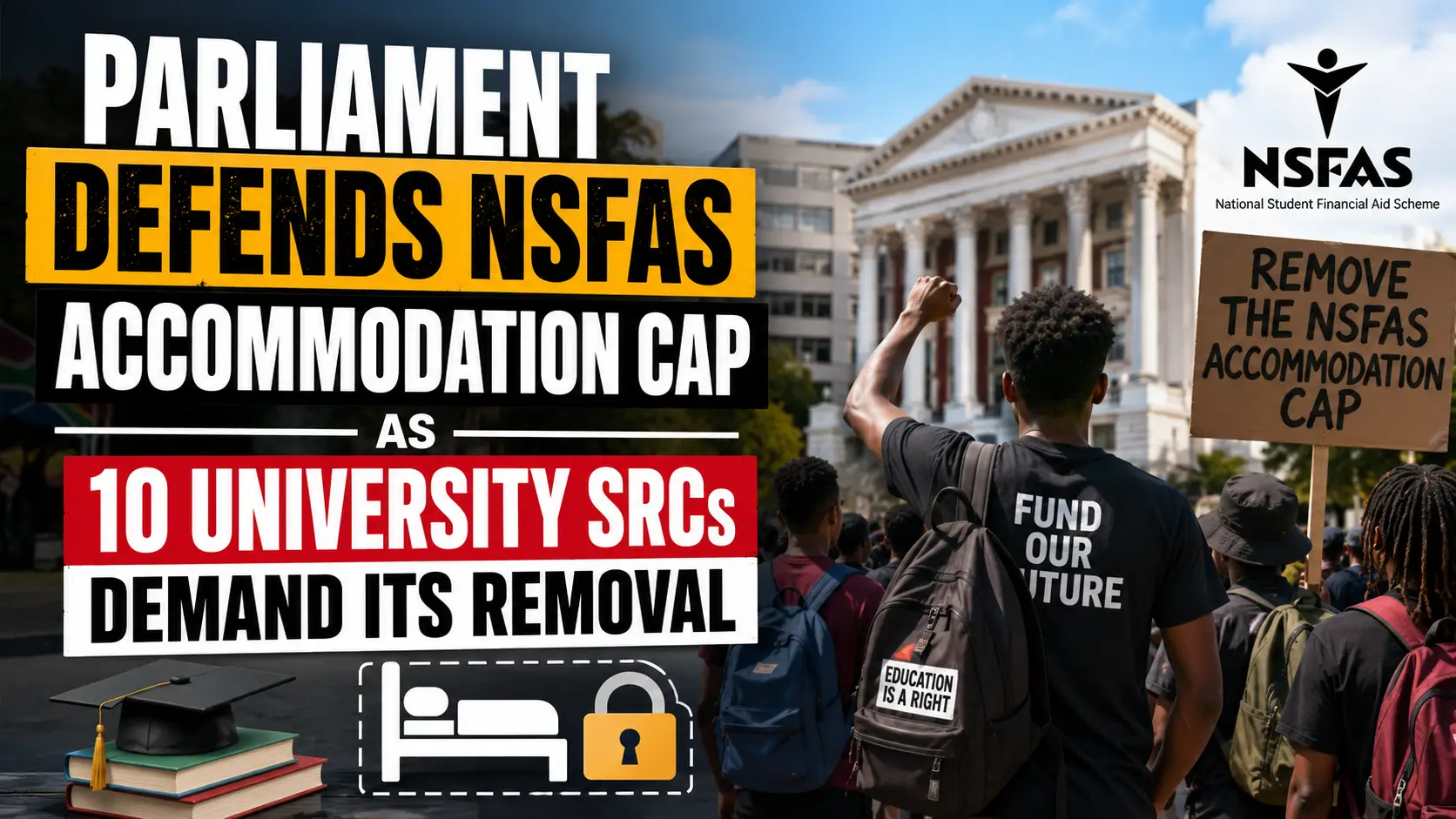
Parliament Defends NSFAS Accommodation. South Africa’s debate over student accommodation funding has intensified after Parliament defended the National Student Financial Aid Scheme (NSFAS) accommodation cap, while student representative councils (SRCs) from 10 universities called for the funding limit to be scrapped. The disagreement highlights growing concerns about the affordability of student housing, rising accommodation costs, and the financial pressures faced by thousands of NSFAS-funded students across the country.

The controversy centres on the accommodation cap introduced by NSFAS to regulate the maximum amount it will pay towards student housing. While Parliament argues that the cap is necessary to prevent excessive pricing by accommodation providers, student leaders believe the funding limit is leaving many students unable to afford suitable accommodation.
Ten University SRCs Unite Against the Accommodation Cap
The campaign against the NSFAS accommodation cap began when the Student Representative Councils (SRCs) of the University of Cape Town (UCT), the University of the Witwatersrand (Wits), the University of Johannesburg (UJ), and Stellenbosch University released a joint statement demanding the immediate removal of the funding limit.
Within days, six additional universities joined the campaign, including the University of Fort Hare, Tshwane University of Technology (TUT), Walter Sisulu University, the University of Venda, Sol Plaatje University, and Nelson Mandela University. Their combined support has strengthened calls for urgent reforms to South Africa’s student accommodation funding system.
The student leaders argue that accommodation costs have increased significantly while NSFAS funding has failed to keep pace with market prices, particularly in cities where rental demand remains high.
Students Raise Concerns About Housing Costs
According to the SRCs, the current accommodation cap has created serious financial difficulties for many students from low-income households.

Student representatives claim that many NSFAS beneficiaries are now forced to pay the difference between the accommodation cap and the actual rental cost. Those unable to cover the shortfall often accumulate accommodation debt, face threats of eviction, experience registration delays, or struggle to continue their studies.
The SRCs have therefore called for several immediate interventions, including:
- The removal of the NSFAS accommodation cap.
- Better regulation of student accommodation pricing.
- The urgent announcement of the official 2026 NSFAS accommodation rates.
- Greater protection for financially vulnerable students.
Student leaders believe these measures would improve access to higher education and reduce financial hardship among NSFAS-funded students.
Parliament Defends the Funding Cap
Despite the growing criticism, Parliament’s Portfolio Committee on Higher Education and Training has defended the accommodation cap.
Committee Chairperson Tebogo Letsie argued that the funding limit is not the root cause of the current accommodation crisis. Instead, he believes universities and private accommodation providers should be held accountable for charging excessively high rental prices.
According to Letsie, Parliament has not been convinced that some accommodation fees charged by universities are reasonable when compared with similar properties located in the same areas.
He questioned why criticism was being directed at NSFAS rather than at institutions and landlords that continue to increase accommodation costs.
Universities and Accommodation Providers Under Scrutiny
Letsie said Parliament intends engaging several key stakeholders to investigate accommodation pricing.
These discussions are expected to include Universities South Africa (USAF), the South African Union of Students (SAUS), the South African Technical Vocational Education and Training Student Association (SASVETSA), the Competition Commission, and representatives from the real estate sector.
The objective is to determine whether accommodation providers are charging fair market rates or inflating prices beyond reasonable levels.
Parliament believes improved oversight could help address the affordability crisis without removing the accommodation cap altogether.
Concerns Over Non-Compliant Student Residences
During the debate, Letsie also raised concerns about some university-managed accommodation facilities that reportedly charge rental fees above the NSFAS funding limit despite failing to meet compliance requirements.
He referred to student residences where accommodation costs allegedly exceed the approved cap while still housing NSFAS-funded students.
According to Parliament, universities should ensure that residences comply with required standards before charging premium rental prices.
These concerns have added another layer to the ongoing debate about accountability within the higher education sector.
National Student Accommodation Colloquium Announced
To address the growing concerns, Parliament has announced that it will host a National Student Accommodation Colloquium on 28 August 2026.
The event will bring together government officials, universities, student organisations, accommodation providers, and other stakeholders to discuss long-term solutions for student housing challenges.
Organisations such as SAUS and SASVETSA are expected to make formal submissions regarding the NSFAS accommodation cap and the broader issue of affordable student accommodation.
The discussions are expected to help shape future policy decisions relating to student housing and financial support.
Bigger Picture
Student accommodation has become one of the most significant financial challenges facing South African higher education.
In many university cities, private accommodation costs have increased rapidly over the past few years, making it increasingly difficult for NSFAS-funded students to secure safe and affordable housing.
Universities have also faced criticism for relying heavily on private accommodation providers due to limited on-campus housing capacity.
As student numbers continue to grow, many experts believe South Africa will need substantial investment in student residences alongside stronger regulation of accommodation pricing.
What Happens Next?
While Parliament continues to defend the accommodation cap, pressure from student organisations is unlikely to ease.
The upcoming Student Accommodation Colloquium is expected to provide an important platform for students, universities, government officials, and industry stakeholders to discuss practical solutions.
Conclusion
Whether this results in changes to the NSFAS accommodation cap or introduces new measures to regulate accommodation pricing remains to be seen.
For now, students across the country are waiting for further announcements regarding the 2026 accommodation rates and hoping that future funding policies will better reflect the realities of South Africa’s rising housing costs.