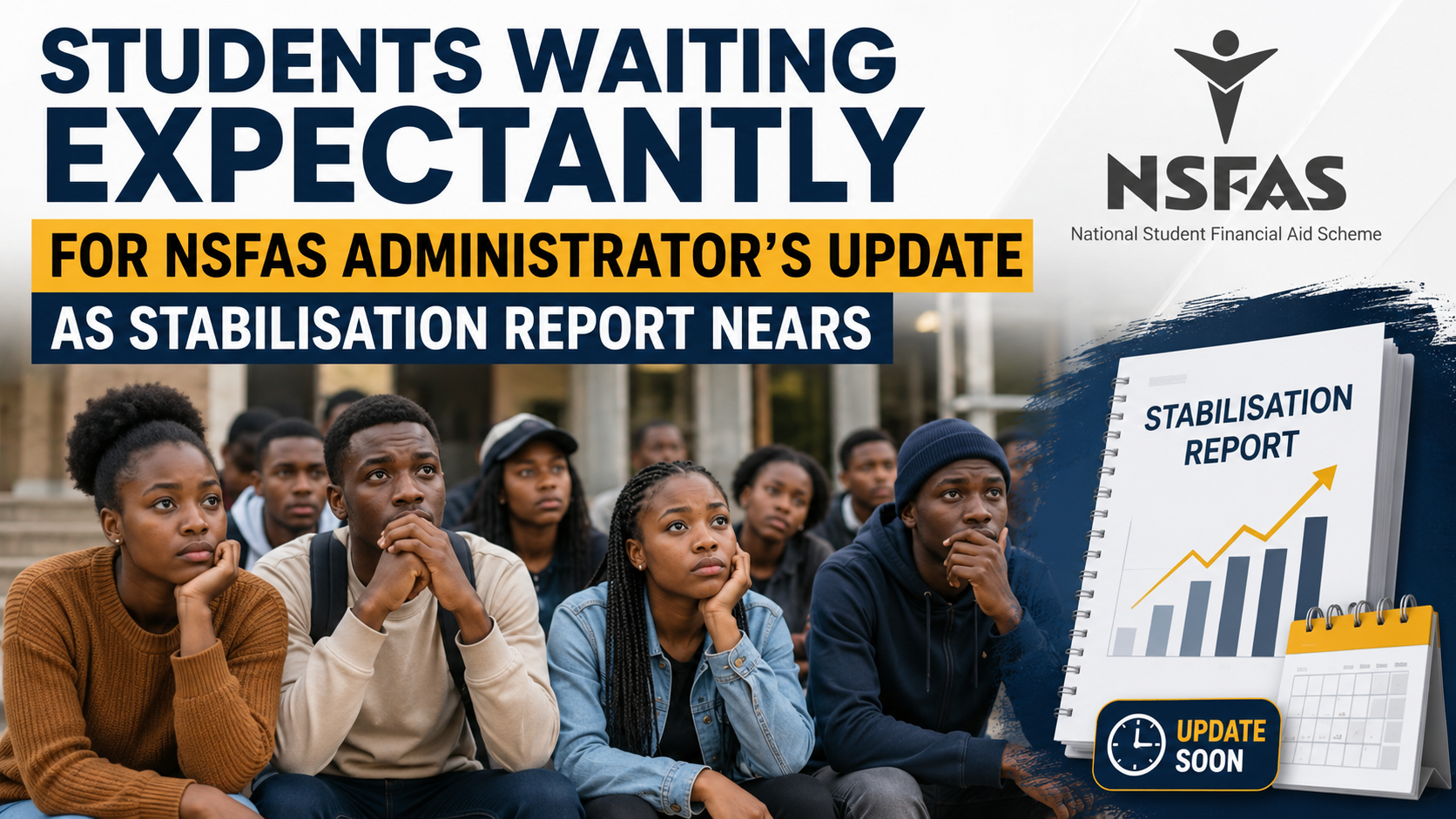
NSFAS Administrator Update. Thousands of students across South Africa are eagerly awaiting an important update from the National Student Financial Aid Scheme (NSFAS) as the organisation prepares to release its long-awaited stabilisation report. The report is expected to provide crucial information on how NSFAS plans to improve its operations, resolve ongoing funding challenges, and strengthen support for students attending public universities and TVET colleges.

The presentation, scheduled for 4 August 2026, will be delivered by the recently appointed NSFAS Administrator, Professor Hlengani Mathebula, to the Minister of Higher Education and Training, Buti Kgwaridi Manamela. Students, universities, and education stakeholders hope the report will introduce practical solutions to the financial and administrative problems that have affected the student funding scheme for several years.
Why the NSFAS Update Matters
NSFAS plays a vital role in South Africa’s higher education system by providing financial assistance to eligible students who cannot afford tertiary education. Every year, hundreds of thousands of students rely on NSFAS funding to cover tuition fees, accommodation, learning materials, and living expenses.
However, administrative delays, funding disputes, payment issues, and governance challenges have placed significant pressure on both students and educational institutions. As a result, many students have struggled to complete their studies without financial uncertainty.
The upcoming update is expected to provide reassurance that meaningful reforms are underway.

Students Unable to Graduate Due to Outstanding Fees
One of the biggest concerns facing South African universities is the growing number of students who have completed their academic programmes but cannot graduate because of unpaid tuition fees linked to NSFAS funding shortfalls.

According to Universities South Africa (USAF), more than 188,000 university certificates remain withheld because institutions have not received outstanding payments. This situation has prevented many graduates from collecting their qualifications, applying for jobs, or continuing with postgraduate studies.
Student organisations have repeatedly called on NSFAS and the Department of Higher Education and Training to urgently resolve these funding gaps and ensure deserving students are not disadvantaged.
Universities Also Face Financial Pressure
The funding delays have affected not only students but also universities across the country. Several institutions have warned that outstanding NSFAS payments are creating serious financial challenges.
University leaders argue that delayed reimbursements reduce available resources for teaching, student services, infrastructure development, and academic support programmes. Many institutions have urged government to accelerate payment processes and improve communication between NSFAS and higher education institutions.
The stabilisation report is expected to address these concerns by outlining measures designed to improve financial management and operational efficiency.
NSFAS Stabilisation Report to Be Presented
Professor Hlengani Mathebula assumed the role of NSFAS Administrator in May 2026 with the responsibility of restoring confidence in the organisation and leading institutional reforms.
As part of his appointment, he was instructed to develop a comprehensive stabilisation plan within three months. The report will now outline the progress made since his appointment and explain how NSFAS intends to improve its services over the coming months.
The presentation scheduled for Tuesday, 4 August 2026, is expected to become an important milestone in the organisation’s recovery process.
Key Areas Expected in the Stabilisation Plan
The NSFAS stabilisation plan is expected to focus on several priority areas that directly impact students and educational institutions.
Some of the key topics expected in the report include:
- Improving student accommodation management.
- Addressing outstanding audit findings.
- Strengthening consequence management and accountability.
- Modernising ICT systems and data integration.
- Ensuring uninterrupted operational continuity.
- Enhancing governance and institutional oversight.
- Improving service delivery for students and universities.
These initiatives are intended to strengthen NSFAS while ensuring greater transparency and accountability across all operations.
90-Day Performance Review
In addition to presenting the stabilisation plan, Professor Mathebula is expected to provide a detailed overview of his first 90 days in office.
The performance update will likely cover several important operational areas, including:
- Progress in processing student funding.
- Improvements in governance structures.
- Financial management reforms.
- Operational performance.
- New interventions aimed at reducing administrative delays.
- Better collaboration with universities and TVET colleges.
This review will help stakeholders understand whether the organisation is making meaningful progress toward restoring confidence in the student funding system.
Focus on Better Student Services
One of the main goals of the new administration is to improve the overall experience for students applying for and receiving NSFAS funding.
Many students have previously reported challenges such as delayed allowance payments, application processing issues, communication difficulties, and verification delays. The stabilisation strategy is expected to introduce systems that make the funding process more efficient, transparent, and student-focused.
Improving digital systems, strengthening internal controls, and enhancing communication channels are expected to play an important role in these reforms.
What Students Can Expect Next
Students across South Africa will closely monitor the outcomes of the presentation, hoping it delivers practical solutions rather than promises alone.
If successfully implemented, the stabilisation plan could improve funding administration, reduce payment delays, strengthen governance, and help universities recover outstanding funds. It may also assist thousands of students whose academic progress has been affected by unresolved financial issues.
The report is expected to provide a roadmap for rebuilding trust in NSFAS while ensuring that eligible students continue receiving the financial assistance they need to complete their higher education.
Conclusion
The upcoming NSFAS Stabilisation Report represents a significant opportunity for South Africa’s student funding system. With students, universities, and government all looking for meaningful reform, the presentation on 4 August 2026 is expected to outline the next phase of NSFAS’s recovery and institutional renewal.