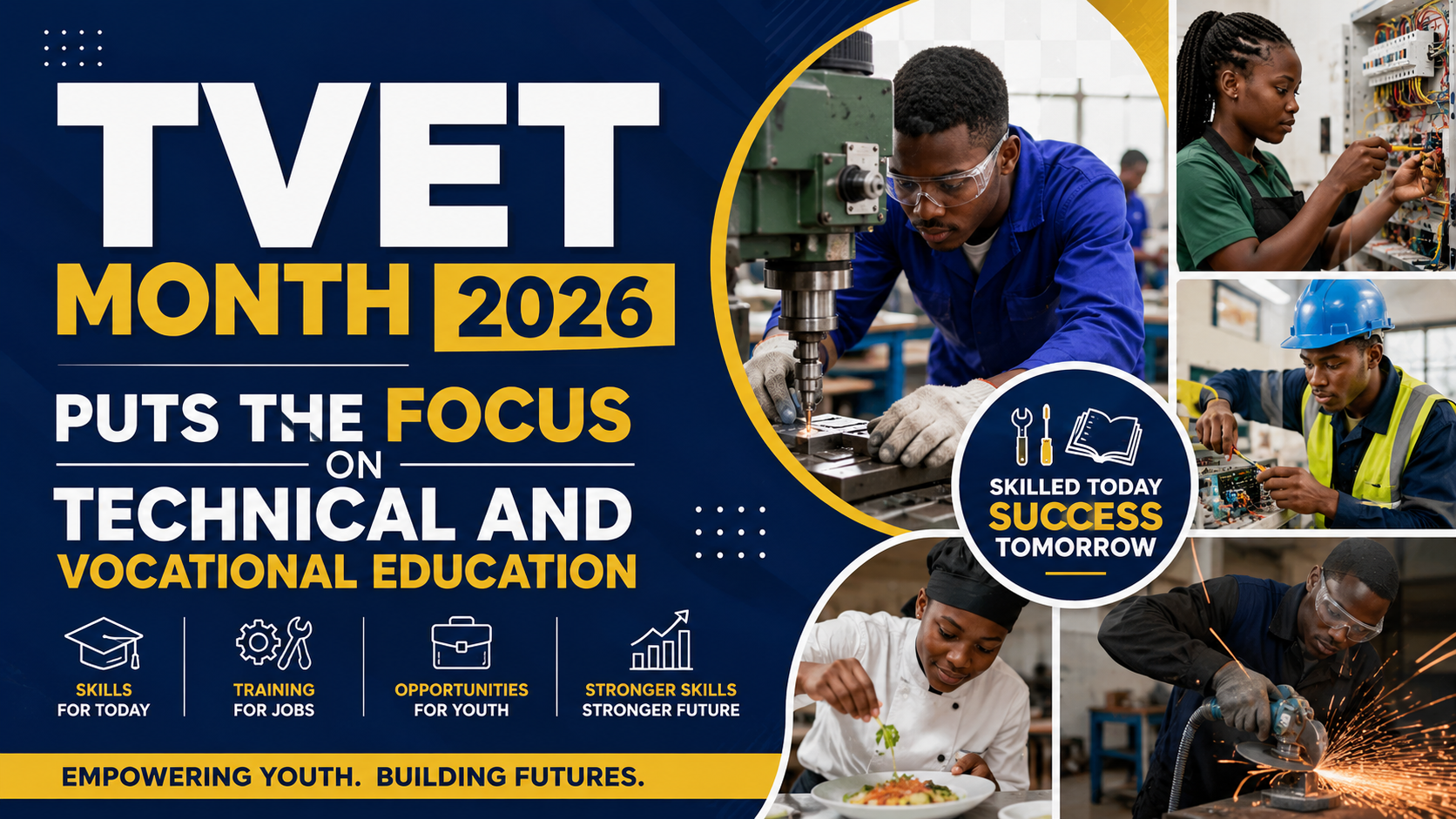
TVET Month 2026 Puts the Focus on Technical. TVET Month 2026 is drawing attention to the important role that Technical and Vocational Education and Training (TVET) colleges can play in preparing South Africa’s young people for employment, entrepreneurship and further education. The initiative is also encouraging a change in how society views vocational education, with a stronger focus on practical skills, workplace experience and the demands of a modern economy.

At the official launch of TVET Month 2026 at Esayidi TVET College, Higher Education and Training Minister Buti Manamela called for TVET colleges to become “institutions of choice” for young South Africans. He emphasised that vocational education should not be viewed as a second option, but rather as an important and deliberate pathway towards careers and economic opportunities.
TVET Education as a Career Pathway
Technical and vocational education provides students with opportunities to develop practical knowledge and occupational skills that can be applied in different industries. These programmes can offer an alternative pathway for learners who want to enter the workplace, start businesses or continue with further education.
Minister Manamela stressed that TVET should be recognised as a purposeful route into occupations, entrepreneurship, employment and additional learning. This message is particularly important as young people make decisions about their education and future careers.
Students are encouraged to investigate the programmes available at TVET colleges and consider how different qualifications and occupational areas connect with the skills required by South Africa’s economy. Making informed career choices can help students select programmes that match their interests while also considering employment opportunities.


Importance of Work-Integrated Learning
One of the key issues highlighted during the TVET Month launch was the need to strengthen Work-Integrated Learning (WIL). Practical workplace exposure can help students understand how the knowledge and skills gained through their studies are used in real working environments.

Classroom learning provides an important foundation, but workplace experience can help students develop additional competencies, confidence and professional understanding. WIL can therefore help create a stronger connection between education and employment.
Minister Manamela called on employers and industry partners to work more closely with TVET colleges. Businesses can contribute by providing students with opportunities to gain practical experience and participate in workplace-based learning.
Stronger partnerships between colleges and industry can also help ensure that training remains relevant to changing workplace requirements. By working together, education institutions and employers can identify skills gaps and provide students with more meaningful opportunities to develop occupational competencies.
TVET Colleges and the Skills Revolution
South Africa’s economy is changing rapidly due to technological development, industrialisation, digital transformation and the transition towards a greener economy. These changes are creating new skills requirements across many sectors.
According to Minister Manamela, TVET colleges have an important role to play in responding to these developments. The institutions can help prepare students for emerging opportunities by strengthening technical, digital and occupational skills.
The growing importance of technology means that students need to be prepared for workplaces that are increasingly influenced by digital tools and innovation. At the same time, the movement towards a green economy is creating demand for skills connected to sustainable technologies, environmental practices and new industries.
This makes the TVET sector an important part of South Africa’s broader skills development strategy.
Connecting Education With Economic Opportunities
A major focus of TVET Month 2026 is the connection between education and real economic opportunities. The goal of occupational education is not simply to help students obtain certificates or qualifications. Instead, students should leave their programmes with practical competence that can be used in workplaces and other economic activities.
This approach can benefit both students and employers. Students gain skills and experience that can improve their readiness for employment, while businesses gain access to people who have been trained in relevant occupational areas.
TVET colleges can also contribute to entrepreneurship by helping students develop practical abilities that may be used to establish and operate small businesses. For young people who choose self-employment, technical skills can become an important foundation for creating income-generating opportunities.
Bringing Stakeholders Together
The launch of TVET Month 2026 brought together learners, students, alumni, industry representatives, media members and other stakeholders. Their participation provided an opportunity to discuss the future of technical and vocational education and the different career pathways available through TVET colleges.
Engagement between these groups is important because the success of the TVET sector depends on cooperation. Colleges need to understand industry requirements, while employers need to participate in developing a workforce with relevant competencies.
Students and alumni can also provide valuable perspectives on their experiences, challenges and opportunities within the TVET system.
Stronger Future for TVET Education
As South Africa continues to respond to technological change, industrial development and the growth of the green economy, the importance of practical skills is expected to increase. TVET colleges are positioned to contribute significantly by preparing students for occupations that support communities and the wider economy.
TVET Month 2026 therefore provides more than an opportunity to promote vocational education. It creates a platform to encourage young people to consider technical and occupational careers seriously and to recognise the value of practical education.
The message from the launch is clear: TVET should be seen as a respected and valuable education pathway. By expanding workplace learning, strengthening industry partnerships and aligning programmes with economic needs, TVET colleges can help equip South Africa’s youth with skills for the future.
Conclusion
For prospective students, TVET education can provide a practical route towards employment, entrepreneurship and further learning. For employers, stronger partnerships with colleges can contribute to the development of a more capable workforce. And for South Africa, a responsive TVET system can play an important role in addressing skills shortages and supporting economic development.
As TVET Month 2026 continues to place vocational education in the spotlight, the focus remains on building a system where qualifications are supported by real competence, practical experience and meaningful connections to the world of work.