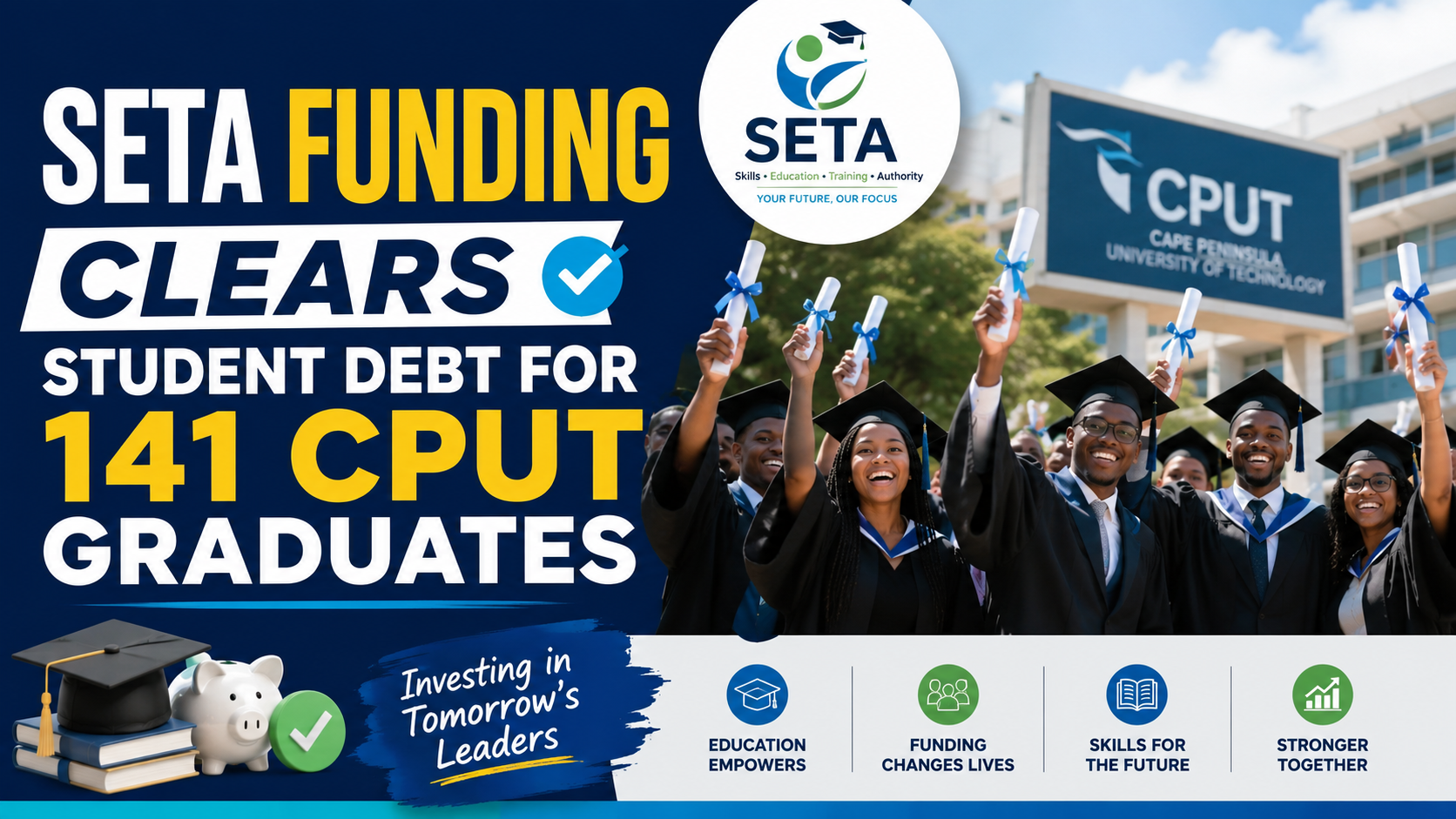
SETA Funding Clears Student Debt. A major step toward improving access to education and employment opportunities has been taken as SETA funding has helped clear outstanding student debt for 141 graduates of the Cape Peninsula University of Technology (CPUT). The initiative provides important financial relief to graduates who may have completed their studies but were still facing challenges because of unpaid university fees.
Student debt can create significant barriers for graduates entering the workplace. Even after successfully completing their qualifications, students with outstanding balances may experience difficulties obtaining academic records, certificates, or other documents needed when applying for employment and further study. By addressing these financial obligations, the funding initiative gives affected graduates a better opportunity to move forward with their careers.
What Is SETA Funding?
Sector Education and Training Authorities, commonly known as SETAs, play an important role in South Africa’s skills development system. They support education, training, workplace learning, internships, learnerships, and other initiatives designed to develop skills that are needed in different industries.
SETA funding can benefit students, graduates, unemployed young people, and employees depending on the specific programme. Funding arrangements may differ between SETAs because each authority focuses on particular economic sectors and skills requirements.
The support provided to the 141 CPUT graduates demonstrates how skills-development funding can extend beyond traditional training opportunities. In this case, financial assistance has helped remove a debt-related obstacle that could otherwise continue affecting graduates after university.


Financial Relief for 141 CPUT Graduates
For the 141 graduates involved, the clearing of outstanding student debt represents more than simply settling an account. It can provide a fresh start at an important stage of their professional lives.
University debt can remain a major concern for students from financially disadvantaged backgrounds. While a student may have successfully completed all academic requirements, outstanding fees can continue to create uncertainty. Graduates may have to delay career plans, search for financial assistance, or struggle to access documents required by employers.
The SETA-supported intervention helps reduce this burden and allows the beneficiaries to concentrate on the next stage of their lives.
For many graduates, completing a qualification is only the beginning. They must then compete for internships, graduate programmes, entry-level positions, and other employment opportunities. Removing financial barriers can make this transition easier.
Why Student Debt Matters
The cost of higher education remains an important issue in South Africa. Students often rely on financial aid, bursaries, family support, loans, or other funding arrangements to complete their studies.
When funding does not cover all expenses, students can accumulate outstanding university balances. These debts may remain even after the student has graduated.
The consequences can extend beyond university. A graduate may have the required qualification and skills but still face administrative or financial obstacles. This can be particularly challenging for young people who are trying to establish themselves in the job market.
Debt relief initiatives therefore have the potential to contribute to broader economic participation. When graduates can access their academic documentation and pursue employment opportunities without the same financial restrictions, they have a better chance of becoming economically active.
CPUT Graduates and Career Opportunities
The Cape Peninsula University of Technology (CPUT) is a major institution of higher education in South Africa, offering qualifications across a wide range of fields. Its graduates enter industries including business, engineering, information technology, health and wellness, design, education, and other professional sectors.
The 141 beneficiaries can now move forward with greater financial certainty after receiving support to address their outstanding student debt.
This type of assistance is especially relevant in a competitive employment environment. Employers frequently require proof of qualifications during recruitment. Graduates may also need academic transcripts or certificates when applying for postgraduate programmes, professional opportunities, or international positions.
Clearing university debt can therefore help remove practical barriers that may otherwise delay these plans.
Broader Role of SETAs
SETA programmes are designed to help address skills shortages and strengthen South Africa’s workforce. Their activities can include funding learnerships, apprenticeships, internships, skills programmes, and other forms of workplace-based learning.
The involvement of SETAs in student support also highlights the connection between education and employment. Developing skills is important, but ensuring that graduates can successfully transition into the workplace is equally valuable.
Financial interventions that help students and graduates overcome barriers can complement other skills-development initiatives. When graduates are able to access opportunities after completing their studies, the investment in their education can have a greater long-term impact.
What This Means for Students
The news is also a reminder for current students and prospective applicants to investigate available financial-support programmes. Students should regularly check official university announcements, government funding opportunities, bursaries, SETA programmes, and other legitimate sources of financial assistance.
However, students should be careful when searching for funding online. Genuine programmes normally provide clear information about eligibility requirements, application procedures, deadlines, and official contact details. Applicants should avoid paying unofficial agents or sharing sensitive information with unverified websites.
Students who are struggling with outstanding fees should also contact their institution’s student finance or financial-aid office to understand what assistance may be available.
Positive Step for Graduate Success
The clearing of student debt for 141 CPUT graduates demonstrates how targeted financial support can make a meaningful difference. Graduation should ideally mark the beginning of a professional journey rather than the continuation of financial obstacles from university.
By helping beneficiaries address their outstanding balances, SETA funding can give these graduates greater freedom to focus on employment, further education, skills development, and career growth.
The initiative also highlights the importance of collaboration between educational institutions, skills-development organisations, and other stakeholders. Supporting students through graduation is valuable, but helping them successfully transition into employment can provide even greater social and economic benefits.
Conclusion
The SETA funding that cleared student debt for 141 CPUT graduates provides an encouraging example of financial assistance helping qualified young people move forward. For the beneficiaries, resolving outstanding university debt may make it easier to access academic documents, pursue employment opportunities, and continue their education.
More broadly, initiatives of this nature demonstrate why student financial support remains important. Education can provide the skills needed for economic participation, but financial barriers can sometimes prevent graduates from fully benefiting from their qualifications.
As South Africa continues to focus on skills development and employment, programmes that reduce barriers for graduates can play an important role. For the 141 CPUT graduates, this support represents an opportunity to begin the next chapter of their careers with fewer financial obstacles and renewed confidence in their professional future.