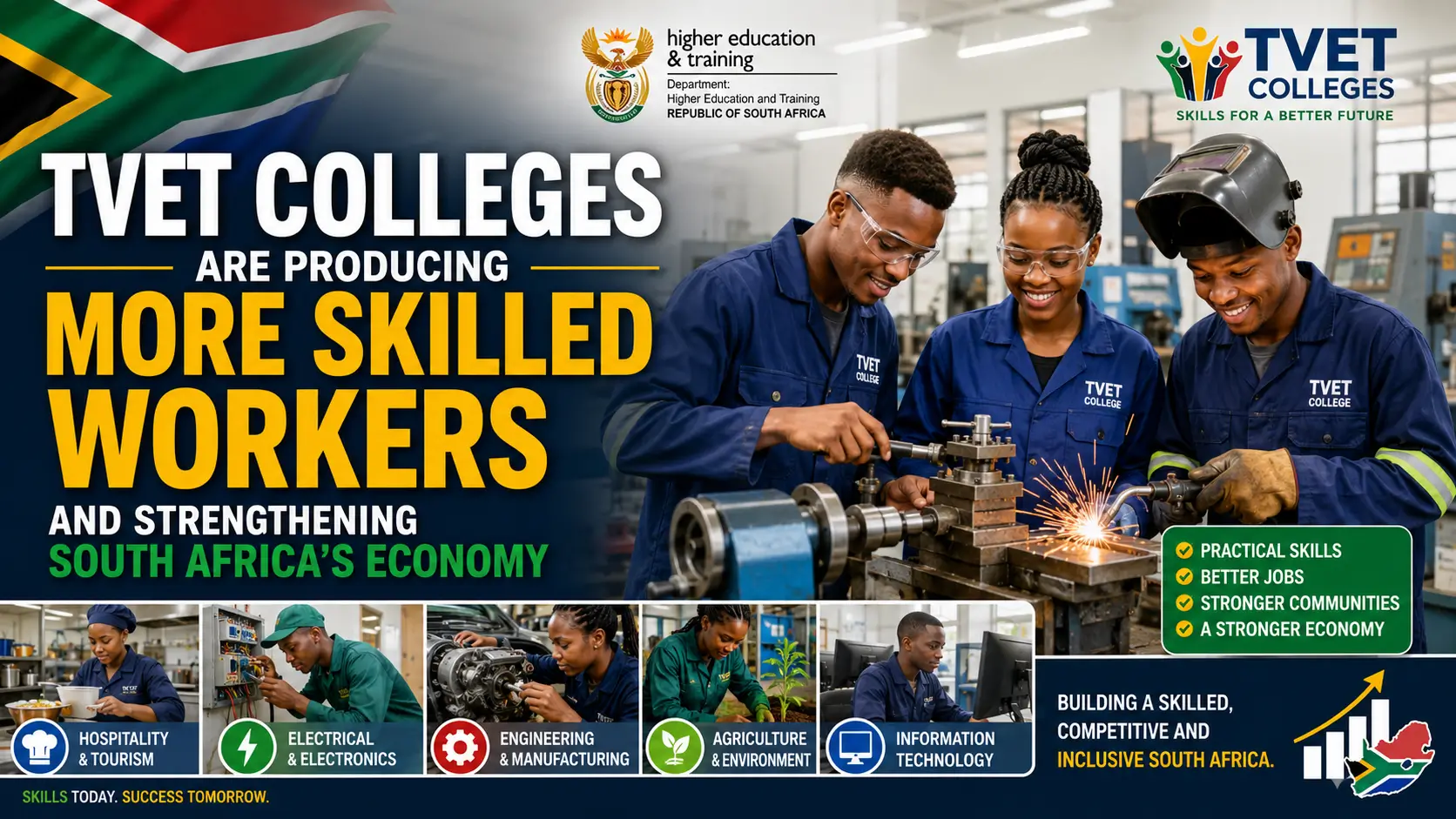
TVET Colleges Are Producing More Skilled. Technical and Vocational Education and Training (TVET) colleges are becoming one of the most important pillars of South Africa’s education system. As industries continue to demand practical skills and qualified professionals, TVET institutions are preparing thousands of young people for successful careers in various sectors. From artisans and technicians to hospitality professionals and entrepreneurs, these colleges are helping create a skilled workforce that supports economic growth and job creation across the country.

Recent research has highlighted the positive impact of TVET colleges, showing that they are producing more qualified workers who are ready to meet the needs of South Africa’s growing industries. Their practical training approach gives students valuable workplace skills, making them more employable while also encouraging entrepreneurship and innovation.
TVET Colleges Supporting Skills Development
The importance of TVET colleges was recently showcased during the Unilever TVET Cook Challenge held in Durban, KwaZulu-Natal. The event highlighted how hospitality and culinary programmes are preparing students for careers in hotels, restaurants, catering businesses, and the tourism industry.
Government leaders attended the event to demonstrate their continued support for the TVET sector. Deputy Minister in the Presidency, Nonceba Mhlauli, emphasized that practical education is essential for South Africa’s long-term economic development. According to her, the government remains committed to strengthening TVET institutions because they produce the skilled professionals needed to keep industries operating efficiently.
She explained that South Africa requires a wide variety of qualified professionals, including electricians, welders, plumbers, mechanics, agricultural specialists, chefs, and hospitality experts. These careers are just as important as traditional professions such as law, accounting, and engineering because they directly contribute to infrastructure development, service delivery, and business growth.


Practical Skills Are Driving Economic Growth
The demand for skilled workers continues to increase as industries seek employees with hands-on experience. Unlike many academic programmes that focus primarily on theory, TVET colleges combine classroom learning with practical training. This enables graduates to enter the workforce with the technical knowledge and real-world experience employers value.

Graduates from TVET colleges contribute to several important sectors, including construction, manufacturing, agriculture, engineering, hospitality, tourism, and automotive services. Their expertise helps businesses improve productivity while supporting national economic development.
By investing in technical education, South Africa is building a workforce capable of meeting current industry demands while preparing for future economic opportunities.
Entrepreneurship Creates New Opportunities
During her address, Deputy Minister Mhlauli encouraged students, particularly those studying hospitality and culinary arts, to view entrepreneurship as an exciting career path instead of relying solely on traditional employment.
She pointed out that many successful business owners started with little more than determination, creativity, and a passion for food. The culinary industry offers numerous opportunities for individuals to establish their own businesses, whether through restaurants, catering services, bakeries, food manufacturing, event management, food styling, tourism, or digital content creation.
According to Mhlauli, today’s small home bakery could eventually become a nationally recognized brand with the right support and dedication. She stressed that entrepreneurship should become a central part of South Africa’s strategy for economic growth because successful entrepreneurs not only build businesses but also create employment opportunities for others.
Government Support for Young Entrepreneurs
To help young entrepreneurs succeed, the South African government continues to provide financial assistance and business development support through several programmes. Eligible entrepreneurs can access funding, mentorship, and training designed to help new businesses grow and become sustainable.
Support is available through organizations such as the National Youth Development Agency (NYDA), the Small Enterprise Development Agency (SEDA), the Small Enterprise Finance Agency (SEFA), and the Industrial Development Corporation (IDC). These initiatives aim to reduce barriers for young business owners while encouraging innovation across different industries.
Students were encouraged to take advantage of these programmes after completing their qualifications. Rather than allowing certificates to remain unused, graduates were advised to use their education as a foundation for building successful businesses that contribute to South Africa’s economy.
Honouring the Legacy of the 1976 Youth
The Deputy Minister also reflected on the significance of the June 16, 1976 Youth Uprising, reminding young South Africans that previous generations fought courageously for equal access to quality education and greater opportunities.
She explained that education has always been viewed as the foundation for freedom, dignity, and prosperity. Today’s investments in TVET education, apprenticeships, bursaries, and entrepreneurship programmes continue the vision established by the youth who sacrificed for a better future.
According to Mhlauli, every apprenticeship created, every bursary awarded, and every young entrepreneur supported represents another step toward achieving the goals of equal opportunity and economic inclusion.
Young People Encouraged to Shape South Africa’s Future
Beyond education and employment, young South Africans were also encouraged to become active participants in democracy. Mhlauli urged eligible citizens to register to vote and contribute to decisions that influence education policies, economic development, investment, entrepreneurship, and employment opportunities.
She emphasized that democracy becomes stronger when young people actively participate in shaping the country’s future instead of remaining observers. By engaging in democratic processes, young citizens can help build an economy that benefits everyone.
Conclusion
TVET colleges are playing a vital role in preparing South Africa’s next generation of skilled workers, entrepreneurs, and industry professionals. Through practical education, workplace training, and career-focused programmes, these institutions are helping reduce skills shortages while supporting national economic growth.
As government investment in technical education continues alongside entrepreneurship support programmes, more young South Africans have the opportunity to build successful careers, establish businesses, and create employment for others. With practical skills, determination, and access to available resources, TVET graduates are well-positioned to contribute to a stronger and more prosperous South African economy.