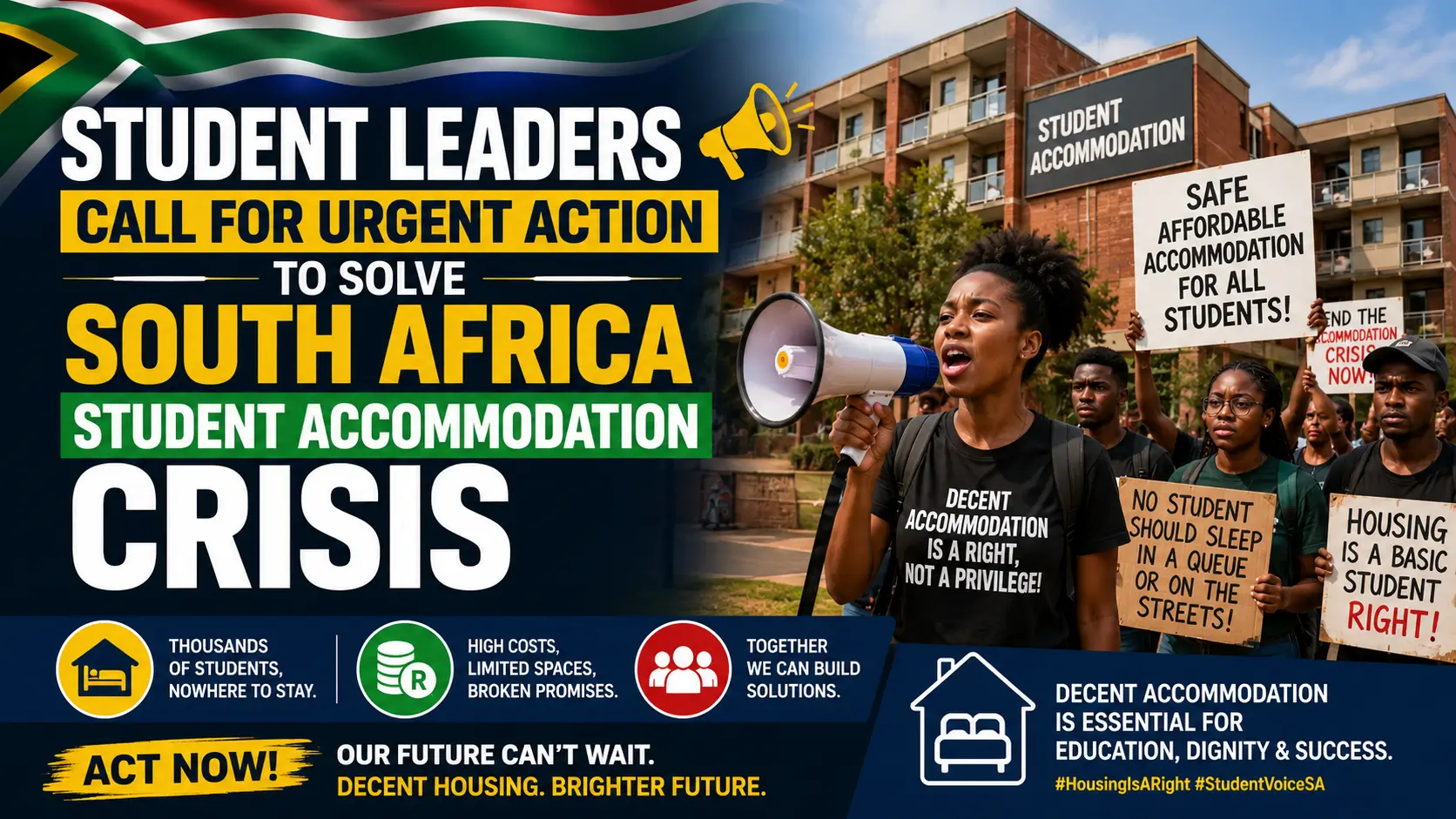
Student Leaders Call for Urgent Action to Solve South Africa. South Africa’s higher education sector is facing increasing pressure as student leaders warn of a growing accommodation crisis affecting thousands of university and TVET college students. To address these concerns, the South African Union of Students (SAUS) has launched the National Student Accommodation Indaba 2026, bringing together government officials, higher education institutions, accommodation providers, and other key stakeholders to develop practical and long-term solutions.

The conference, which officially began on 2 July 2026 at the University of KwaZulu-Natal (UKZN), aims to improve the quality, affordability, and sustainability of student housing across the country. Organizers believe the discussions will play a crucial role in shaping future policies that ensure students have access to safe and dignified accommodation throughout their academic journey.
National Student Accommodation Indaba 2026 Focuses on Long-Term Solutions
The National Student Accommodation Indaba 2026 is being led by the Minister of Higher Education and Training, Buti Manamela, under the theme:
“From Policy to Practice: Advancing Dignified, Affordable and Sustainable Student Housing in South Africa.”
The event has attracted a wide range of participants, including student representatives, government departments, public institutions, universities, TVET colleges, municipalities, private accommodation providers, development finance institutions, regulators, and housing experts.

The main objective of the conference is to encourage collaboration among all stakeholders so they can develop realistic and sustainable strategies to improve South Africa’s student accommodation system. With student enrolment continuing to grow, the need for reliable housing has become more urgent than ever.
Why Student Accommodation Has Become a National Concern

Student leaders argue that the accommodation crisis extends far beyond the simple shortage of available rooms. Many students continue to experience financial difficulties, delayed accommodation payments, safety concerns, and poor living conditions that negatively affect their education.
Affordable accommodation remains one of the biggest challenges facing students, particularly those from low-income households who depend on government financial assistance. Even when accommodation is available, many students struggle with additional costs that make it difficult to continue their studies without financial stress.
The National Student Accommodation Indaba seeks to identify these problems and recommend practical solutions that can benefit both current and future students.
Key Issues Being Discussed at the Indaba
Delegates attending the conference are examining several important challenges that continue to affect student housing throughout South Africa.
Some of the major discussion topics include:
- Funding models for student accommodation.
- Infrastructure development and expansion.
- Governance and regulatory improvements.
- Student safety, security, and wellbeing.
- Accreditation and compliance of accommodation providers.
- Transformation within the accommodation sector.
- Long-term sustainability of student housing projects.
Each of these topics plays an important role in ensuring that students have access to quality accommodation that supports their academic success while maintaining acceptable living standards.
Minister Buti Manamela Addresses Student Housing Challenges
During his keynote address, Higher Education and Training Minister Buti Manamela acknowledged that South Africa’s student accommodation problems are far more complex than simply increasing the number of available beds.
According to the minister, the sector continues to face challenges involving governance, funding, delayed payments, regulation, accreditation, affordability, student safety, and coordination between institutions.
He explained that many students have raised genuine concerns regarding delayed payments to accredited accommodation providers, threats of eviction, unexpected top-up fees, historical accommodation-related debt, slow accreditation processes, unsafe living conditions, and inconsistent enforcement of accommodation standards.
The minister emphasized that these concerns deserve serious attention and should be addressed through evidence-based policy decisions and constructive engagement among all stakeholders.
Importance of Collaboration Across the Higher Education Sector
One of the primary goals of the National Student Accommodation Indaba is to strengthen cooperation between government, educational institutions, private accommodation providers, and student organizations.
Student housing remains a shared responsibility that requires coordinated planning, adequate funding, effective regulation, and continuous monitoring. By bringing together experts from different sectors, SAUS hopes to create practical recommendations that can improve the student accommodation system for years to come.
Collaboration is expected to help identify funding opportunities, improve regulatory oversight, encourage investment in new student housing developments, and strengthen partnerships between public and private sectors.
Creating Safe, Affordable and Sustainable Student Housing
Student accommodation is an essential part of the higher education experience. Safe and affordable housing allows students to focus on their studies without worrying about financial pressure, unsafe living conditions, or the possibility of eviction.
The conference also highlights the importance of ensuring that accommodation providers meet required standards while offering quality facilities that support student wellbeing. Sustainable housing development is expected to remain a major priority as South Africa continues expanding access to higher education.
Improving accommodation infrastructure can also contribute to better academic performance, increased student retention, and higher graduation rates across universities and TVET colleges.
Conclusion
The National Student Accommodation Indaba 2026 represents an important step toward addressing one of South Africa’s most pressing higher education challenges. While the discussions are still ongoing, the conference is expected to produce recommendations that will influence future policies, funding strategies, and housing development initiatives.
Student leaders remain hopeful that stronger collaboration between government, educational institutions, and accommodation providers will result in meaningful reforms that benefit students across the country.
As demand for higher education continues to grow, ensuring access to dignified, affordable, and sustainable student accommodation will remain essential for supporting student success and strengthening South Africa’s education system.