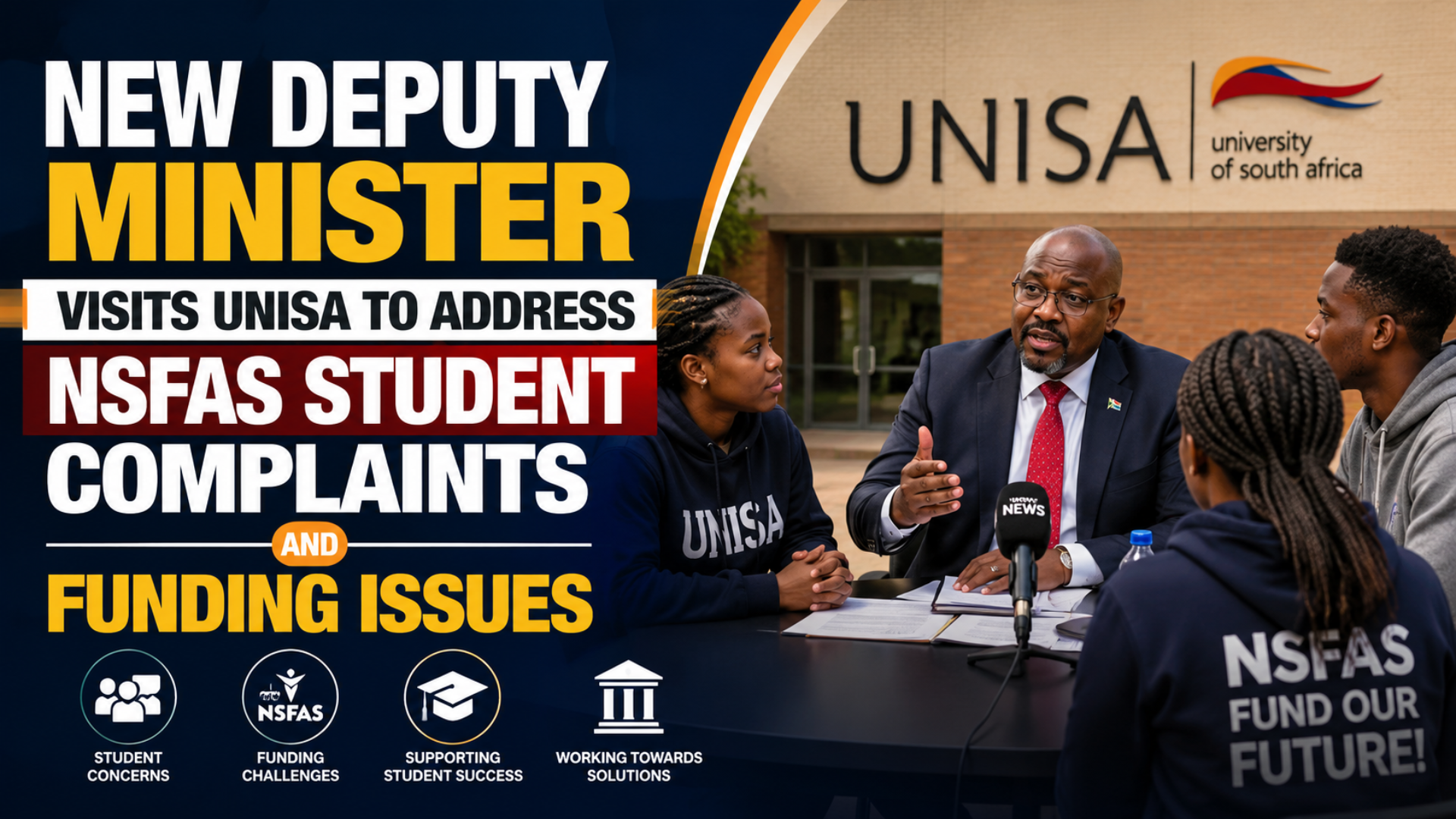
New Deputy Minister Visits Unisa. South Africa newly appointed Deputy Minister of Higher Education and Training, Yusuf Cassim, has made the University of South Africa (Unisa) the destination of his first official visit since taking office. The visit was prompted by a growing number of complaints from NSFAS-funded students who have reported ongoing challenges related to financial aid, delayed allowances, and academic support.

Cassim’s decision to prioritize Unisa highlights the government’s commitment to improving student welfare and ensuring that concerns raised by beneficiaries of the National Student Financial Aid Scheme (NSFAS) receive immediate attention.
Yusuf Cassim Begins His New Role with a Focus on Students
Following South Africa’s recent Cabinet reshuffle, Yusuf Cassim was promoted to Deputy Minister of Higher Education and Training. Before joining the executive, Cassim served as a Member of Parliament on the Higher Education Committee and built his reputation as a student leader.
A member of the Democratic Alliance (DA), Cassim previously served as the Student Representative Council (SRC) President at Nelson Mandela University while leading the Democratic Alliance Student Organisation (DASO). His background in student leadership has shaped his commitment to addressing issues affecting university students across the country.
Choosing Unisa as his first official destination demonstrates his intention to place student concerns at the center of his work.

Why Unisa Was Selected for the First Official Visit
According to Cassim, numerous complaints submitted through the Deputy Minister’s Helpdesk identified Unisa as one of the institutions where students were facing significant challenges.

To better understand the issues, he visited the university alongside officials from the Department of Higher Education and Training (DHET) as well as senior representatives from NSFAS. The delegation met with Unisa’s leadership to discuss the problems raised by students and explore possible solutions.
The Deputy Minister emphasized that direct engagement with institutions is essential to improving the higher education system and ensuring students receive the support they deserve.
Main Complaints Raised by NSFAS Students
During the meeting, several recurring issues affecting NSFAS-funded students were discussed.
Delayed Allowance Payments
One of the biggest concerns remains the late payment of student allowances. Many students rely on these funds to cover daily living expenses, including accommodation, food, transportation, and study materials.
Payment delays can place students under financial pressure and negatively impact their academic performance.
Concerns About Funding Policies
Students also questioned certain NSFAS policies, particularly those determining the amount of financial support they receive. Some believe that current funding allocations do not adequately meet the actual cost of studying.
The Deputy Minister acknowledged these concerns and indicated that they would form part of ongoing discussions with relevant stakeholders.
Data Support Challenges
Another major issue involves internet connectivity and access to online learning resources.
Students expressed frustration over the discontinuation of mobile data support previously provided by Unisa outside examination periods. Since Unisa operates primarily through distance learning, reliable internet access is critical for attending online classes, downloading study materials, completing assignments, and communicating with lecturers.
Without sufficient data, many students struggle to participate fully in their academic programs.
Students Need Better Academic Resources
Cassim noted that students believe they lack the resources needed to succeed academically.
He explained that access to financial assistance alone is not enough. Students also require consistent digital support, learning materials, and reliable communication channels to perform well in their studies.
The Deputy Minister reaffirmed the department’s commitment to working with universities and NSFAS to identify practical solutions that improve the student experience.
Student Leadership Participates in Discussions
The meeting also included Unisa SRC President Nkosinathi Mabilane, who presented the concerns raised by students.
Student representatives play a crucial role in ensuring that learners’ voices are heard by university management and government officials. Their participation helped provide firsthand insight into the challenges students continue to face throughout the academic year.
The discussions aimed to strengthen cooperation between the university, government departments, NSFAS, and student leadership.
Deputy Minister’s Helpdesk Continues to Support Students
Cassim confirmed that he will continue operating the Deputy Minister’s Helpdesk, an initiative introduced by former Deputy Minister Dr. Mimmy Gondwe.
The Helpdesk serves as a direct communication platform where students can report problems related to higher education institutions, NSFAS funding, and other issues requiring government intervention.
Since its launch in August 2024, the Helpdesk has become an important resource for students seeking assistance.
Helpdesk Achieves Strong Resolution Rate
The initiative has produced encouraging results over the past two years.
Earlier this year, Dr. Mimmy Gondwe reported that the Helpdesk had received more than 57,000 student enquiries. Of those, approximately 55,000 cases were successfully resolved, resulting in a resolution rate of nearly 90%.
These figures demonstrate the value of providing students with a direct channel to government officials when institutional processes fail to resolve their concerns quickly.
Government Commits to Improving Student Support
The Deputy Minister’s visit to Unisa sends a strong message that student concerns remain a priority for the Department of Higher Education and Training.
By engaging directly with university management, NSFAS officials, and student leaders, Cassim hopes to identify practical solutions that improve funding administration, strengthen academic support, and ensure students have the tools they need to succeed.
While challenges such as delayed allowances and limited digital access continue to affect many students, ongoing collaboration between government, universities, and NSFAS could lead to meaningful improvements in the months ahead.
Conclusion
Yusuf Cassim first official visit as Deputy Minister reflects a student-centered approach to higher education. By addressing NSFAS complaints at Unisa and continuing the Deputy Minister’s Helpdesk, he aims to improve communication, resolve funding issues more efficiently, and ensure students receive the financial and academic support necessary for successful learning. The visit marks an important step toward strengthening trust between students, universities, and the government.