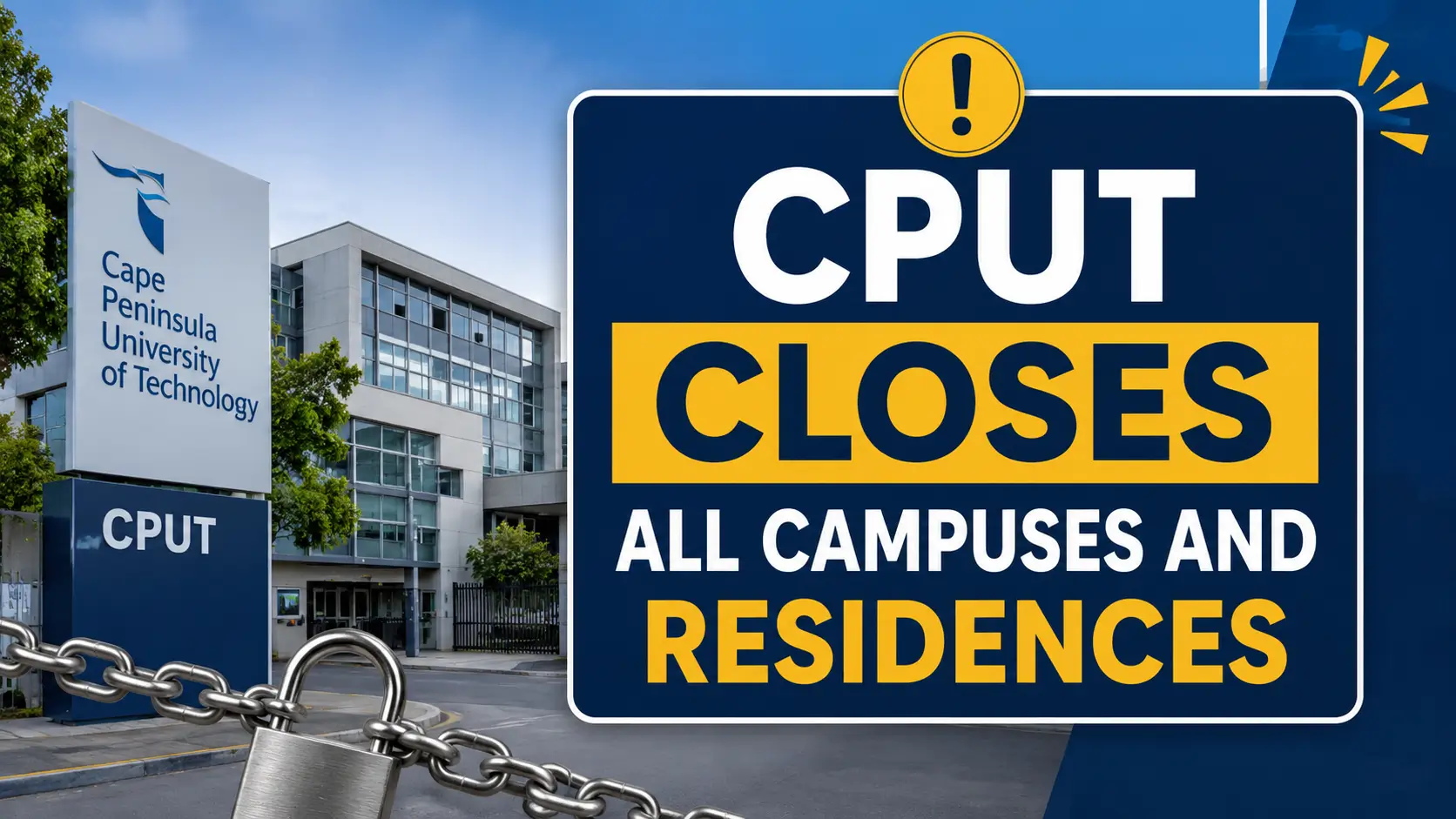
CPUT Closes All Campuses and Residences. The Cape Peninsula University of Technology (CPUT) has announced the immediate closure of all its campuses and the evacuation of university residences following an arson attack and escalating violent protests. The decision was announced on Tuesday, 18 August 2026, as university management raised concerns about the safety of students, staff and other members of the campus community.

The shutdown comes after several days of demonstrations linked to concerns over student registration fees, outstanding debt and accommodation costs. Although the university had withdrawn its proposed debt recovery plan, protests continued and eventually escalated into incidents involving the burning of property and attacks on university infrastructure.
CPUT Campuses Closed Until Further Notice
In an urgent communication to students and staff, CPUT said all campuses would remain closed until further notice as a safety measure. Academic activities have been suspended, while staff members have been instructed to continue their duties remotely from home.
The university’s decision followed a fire at the Old Education Building on the Bellville campus. Fire officials were called to respond to the blaze, which CPUT described as another serious escalation in the ongoing unrest.
University management said continued violent disruptions, the torching of buildings and damage to institutional infrastructure had created an unacceptable safety risk. According to CPUT, the situation had reached a stage where there was a possibility that someone could suffer serious injury or even lose their life.


The university therefore decided that closing campuses was necessary to prevent further escalation and protect the wider university community.
Students Ordered to Leave Residences

Along with the campus shutdown, CPUT has ordered students living in university residences to vacate their accommodation.
Students and staff residing in university facilities were given until 16:00 on Wednesday, 19 August 2026, to leave the residences. At the time of the announcement, the university had not provided a confirmed date for when campuses or residences would reopen.
The evacuation order has raised concerns among students who do not live in Cape Town permanently and may have limited financial resources to travel home.
Student representatives have also questioned whether students were given sufficient time to make alternative accommodation and travel arrangements.
Parliament Committee Chairperson Addresses Students
Walter Letsie, Chairperson of Parliament’s Portfolio Committee on Higher Education, engaged with students during the protests and raised concerns about the university’s decision to require students to leave residences within a short period.
Letsie pointed out that many affected students are beneficiaries of the National Student Financial Aid Scheme (NSFAS). He argued that students who depend on financial assistance may not have access to food, transport money or alternative accommodation.
He said government support is intended to provide qualifying students with tuition, accommodation and allowances because they lack the financial means to cover these expenses themselves.
At the same time, Letsie condemned the destruction of university property. He stressed that damage to buildings and infrastructure ultimately affects both current and future generations of students.
He also suggested that the unrest might have been avoided if university management and students had engaged more effectively before the situation deteriorated.
SRC Raises Concerns Over Evacuation
CPUT Student Representative Council (SRC) President Liyabulela Gela also criticised the university’s decision to evacuate students at short notice.
Gela argued that many students come from outside Cape Town and may not have the money required to travel home immediately. The sudden evacuation could therefore create additional pressure for students and their families.
Student leaders maintain that the protests are driven by specific demands that they believe can be resolved through negotiations with university management.
The SRC has called for meaningful engagement between students and the university rather than measures that could further increase tensions.
Dispute Over R7,000 Registration Fee
The protests began in connection with CPUT’s proposed student debt recovery strategy. The university was reportedly dealing with approximately R4.2 billion in outstanding student debt.
Under the proposed plan, students would have been required to pay a mandatory R7,000 registration fee, along with a portion of their outstanding debt, before completing registration.
The proposal also sought to remove an existing option that allowed some students to register by signing a debt pledge.
Students strongly opposed the proposed changes and submitted memoranda outlining their demands to university management.
Following the demonstrations, CPUT withdrew the proposed debt recovery plan. However, the withdrawal did not immediately end the protests, and demonstrations continued at different university locations.
Protests Escalate at Multiple Campuses
The unrest has not been limited to one CPUT campus. Violent incidents have been reported at different locations, including Bellville and Wellington.
At the Wellington campus, a security vehicle was reportedly set alight. The fire at the Old Education Building in Bellville represented another serious incident during the period of unrest.
The protests involved the university’s central SRC as well as members of various student organisations, including the Pan-Africanist Student Movement of Azania, the Economic Freedom Fighters Students’ Command and the uMkhonto weSizwe Student Movement.
The involvement of multiple student organisations has contributed to the scale of the demonstrations and increased pressure on university management to address students’ concerns.
Accommodation Fees Remain a Major Concern
Another important issue in the dispute is the cost of student accommodation.
NSFAS provides financial support to eligible students, including assistance related to accommodation. However, student representatives across South Africa have raised concerns about the accommodation funding cap and the cost of university housing.
Letsie has supported the continuation of an accommodation cap while also criticising universities that charge accommodation fees above the amount covered by NSFAS.
The issue has created additional tension between students, universities and policymakers, particularly for students who rely entirely on financial aid.
What Happens Next?
For now, CPUT students should follow official university communication regarding academic activities, registration, residence arrangements and the eventual reopening of campuses.
The immediate priority remains restoring safety and preventing further violence. At the same time, students and their representatives are calling for meaningful negotiations to address registration, debt and accommodation concerns.
The closure of all CPUT campuses highlights the serious consequences that can arise when disputes between students and university management escalate into violent protests and property destruction.
Conclusion
While the university says its decision is necessary to protect lives and infrastructure, student leaders and political representatives have raised concerns about the impact of the sudden shutdown and residence evacuation on financially vulnerable students.
The situation remains developing, and the reopening date for CPUT campuses and residences has not yet been announced. Students are therefore advised to monitor official CPUT announcements for the latest updates and any changes to academic schedules or accommodation arrangements.