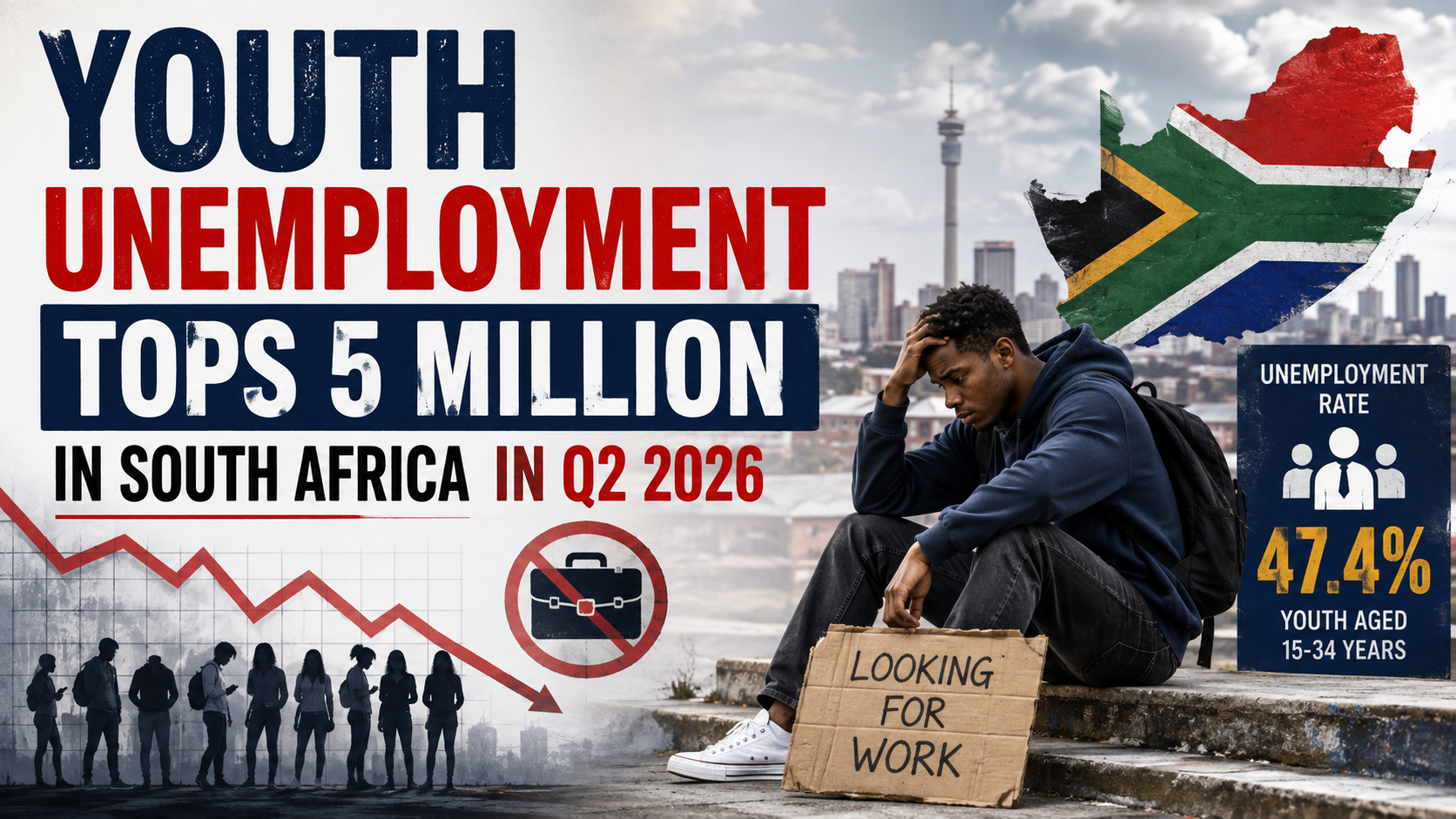
Youth Unemployment Tops 5 Million. South Africa latest unemployment figures have raised fresh concerns about the country’s youth employment crisis. According to the Quarterly Labour Force Survey (QLFS) for the second quarter of 2026, the number of unemployed young people aged between 15 and 34 has reached 5.0 million.

The latest figures from Statistics South Africa (Stats SA) show that unemployment increased across the country during the second quarter, while the number of employed people declined slightly. The situation is particularly concerning for young people, who continue to face significant barriers when entering the labour market.
South Africa’s Unemployment Rate Rises to 33.6%
The official unemployment rate increased from 32.7% in Q1 2026 to 33.6% in Q2 2026, representing an increase of 0.9 percentage points.
According to the latest QLFS results, the number of unemployed people increased by approximately 345,000 to 8.5 million. At the same time, the number of employed people decreased by 16,000 to 16.7 million.
These changes resulted in the labour force increasing by approximately 329,000 people, or 1.3%, during the quarter.


The figures highlight the continued pressure on South Africa’s labour market, where millions of people are actively looking for employment but are unable to find suitable opportunities.
Youth Unemployment Reaches 5 Million

Young South Africans are experiencing an even more difficult employment environment. The number of unemployed people aged 15 to 34 increased by 264,000 to 5.0 million during the second quarter of 2026.
At the same time, youth employment declined by approximately 40,000 to 5.6 million.
As a result, the youth unemployment rate increased by 1.5 percentage points to 47.4%.
This means almost half of young people participating in the labour market are unemployed under the official unemployment measure. The figure demonstrates the scale of the challenge facing young people seeking their first job, building work experience or developing sustainable careers.
Why Youth Unemployment Remains a Major Concern
Youth unemployment can have long-term consequences for individuals and the wider economy. Young people who remain outside the labour market for extended periods may struggle to gain practical experience, develop professional networks and build financial independence.
For many young job seekers, the challenge is not simply a lack of willingness to work. Limited vacancies, skills mismatches, lack of experience and economic conditions can make it difficult for young people to secure employment.
The latest unemployment figures therefore underline the importance of creating more entry-level opportunities, supporting entrepreneurship and improving access to relevant education and workplace skills.
Discouraged Job Seekers Decline
The QLFS also measures people who are not employed and have stopped actively searching for work. These individuals are classified as discouraged job seekers.
During Q2 2026, the number of discouraged job seekers decreased by 227,000 to 3.7 million.
Other potential job seekers also declined. The number of other available job seekers fell by approximately 49,000 to 861,000, while unavailable job seekers decreased by 4,000 to 44,000.
Overall, these changes resulted in a net decrease of approximately 280,000 people in the potential labour force, bringing the total to around 4.6 million.
Although a decline in discouraged job seekers may appear positive, it does not necessarily mean that employment opportunities have improved. The broader labour market figures continue to show considerable pressure.
Gender Gap in Youth Unemployment
The latest figures also highlight a continuing gender gap in youth unemployment.
Young women face particularly difficult employment conditions, with the NEET rate—which measures young people who are Not in Employment, Education or Training—remaining higher among females than males.
Among young people aged 15 to 24, approximately 38.2% of females were classified as NEET, compared with 34.6% of males.
The female NEET rate also increased by around 1.6 percentage points compared with the same period of the previous year.
These figures indicate that young women continue to face additional challenges when attempting to transition from education into employment.
Impact on Young Women
The widening gender gap is an important part of South Africa’s youth employment challenge. While women make up a significant share of participation in higher education, educational participation does not always translate into equal employment opportunities.
Talita Boodhram, Co-Founder and Chief Impact Officer at MiDesk Global, has highlighted concerns about the continuing gap between young men and women in the labour market.
The QLFS results for both the first and second quarters of 2026 indicate that the female NEET rate remains higher than the male rate.
Addressing this gap will require targeted employment initiatives, skills development, career support and opportunities that help young women move successfully from education into the workplace.
What the Latest Figures Mean
The Q2 2026 unemployment statistics present a challenging picture for South Africa. Overall unemployment has increased, youth unemployment has reached 5 million, and the youth unemployment rate has climbed to 47.4%.
The figures also show that employment decreased slightly during the quarter, while the number of unemployed people increased significantly.
For policymakers, businesses and education providers, the data reinforces the need for stronger measures to support young job seekers. Expanding apprenticeships, internships, vocational training, entrepreneurship programmes and entry-level employment could help young people gain the experience needed to participate successfully in the economy.
Conclusion
South Africa’s latest labour market figures show that youth unemployment remains one of the country’s most serious economic and social challenges. With approximately 5 million young people unemployed and the youth unemployment rate reaching 47.4%, the need for effective employment solutions remains urgent.
The gender gap adds another layer to the challenge, as young women continue to record higher NEET rates than young men.