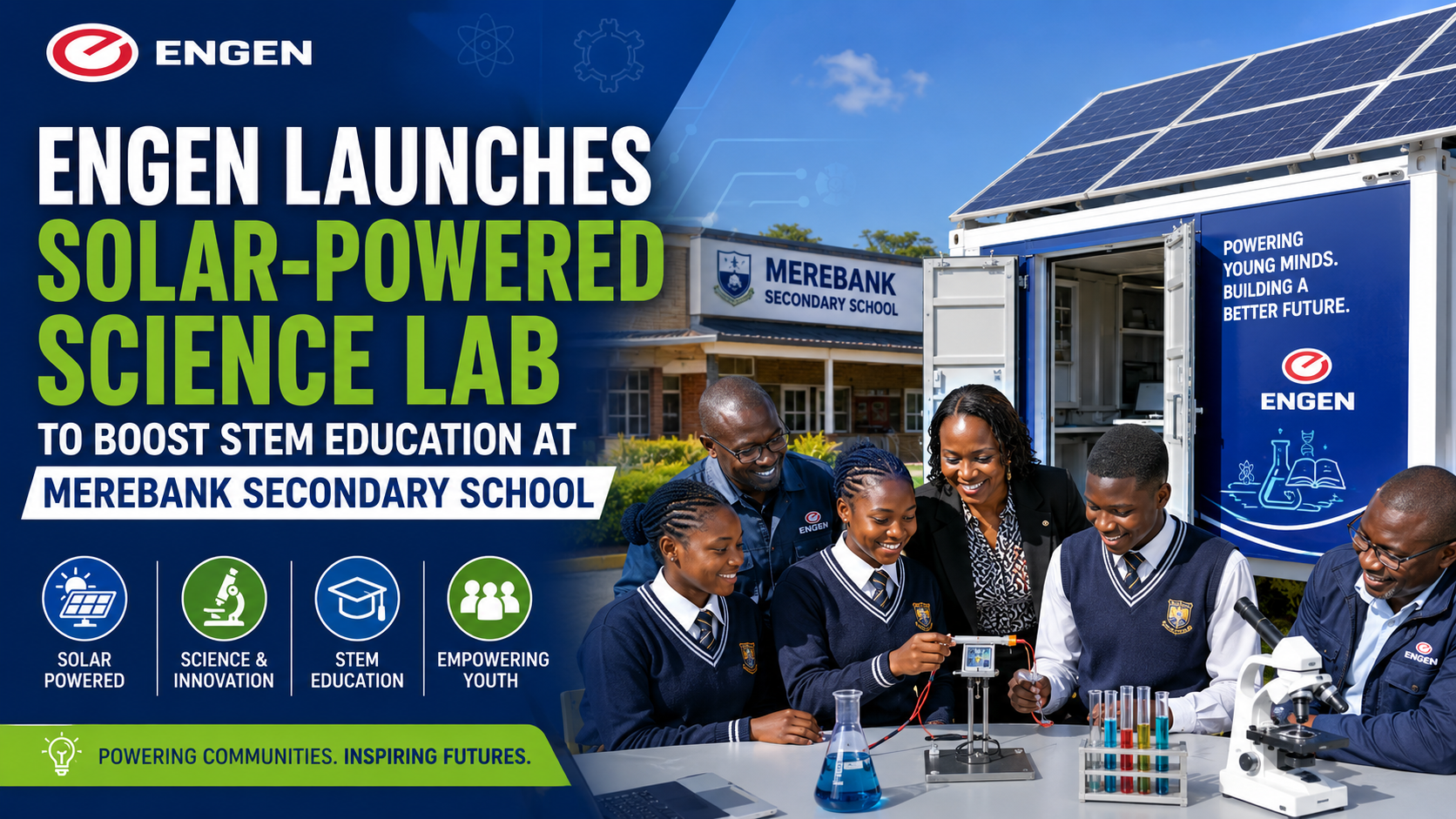
Engen Launches Solar-Powered Science. Learners at Merebank Secondary School in South Durban will now enjoy uninterrupted science and STEM education thanks to a new solar-powered science laboratory donated by Engen. The innovative project ensures that practical science lessons can continue even during electricity outages while reducing the school’s energy costs.

The initiative reflects Engen’s ongoing commitment to supporting quality education, renewable energy, and the development of future scientists, engineers, and technology professionals in South Africa.
Engen Unveils Solar-Powered Science Lab
On 24 July 2026, Engen officially handed over a 15kW portable solar-powered learning container to Merebank Secondary School in South Durban.
The project was designed and delivered by Engen Business & Energy Solutions (EBES) and implemented by the company’s engineering team.
The solar-powered unit provides a dedicated electricity supply to the school’s science laboratory, ensuring students can continue practical science lessons without disruption during power outages.


Why the Project Matters
Reliable electricity has become essential in modern classrooms, particularly for schools offering science, technology, engineering, and mathematics (STEM) education.

Power interruptions can delay laboratory experiments, computer-based learning, and other practical activities that require electricity. By installing a solar-powered energy solution, Engen is helping create a more reliable and sustainable learning environment.
This initiative also demonstrates how renewable energy can improve educational outcomes while reducing operating costs for schools.
Features of the Solar-Powered Learning Container
The newly installed solar-powered learning container includes several advanced features designed to ensure uninterrupted learning.
15kW Solar Power System
The portable unit generates clean electricity using solar energy, reducing dependence on the national power grid.
Integrated UPS (Uninterruptible Power Supply)
An integrated UPS automatically provides backup power whenever there is an electricity outage, allowing laboratory equipment and classroom activities to continue without interruption.
Portable and Scalable Design
The system is compact, self-contained, and can be expanded or relocated if required, making it suitable for various educational environments.
Reliable Energy Supply
The container provides a consistent source of electricity specifically for the school’s science laboratory.
Benefits for Learners and the School
The new solar-powered laboratory is expected to benefit nearly 600 learners who participate in science and STEM-related subjects.
Key benefits include:
- Uninterrupted practical science lessons
- Reliable electricity during load shedding and power outages
- Reduced electricity expenses
- Increased access to after-school learning programmes
- Better STEM education opportunities
- Enhanced hands-on learning experiences
- More sustainable school operations
The savings on electricity bills can also be redirected toward improving other educational facilities and student resources.
Engen Highlights the Importance of Reliable Energy
According to Olwethu Mdabula, Engen’s Corporate Social Investment (CSI) Manager, dependable electricity is essential for providing quality education.
He explained that investing in sustainable energy infrastructure helps learners continue exploring science, technology, and innovation while supporting a cleaner and more sustainable future.
Engen believes that combining education with renewable energy creates long-term opportunities for learners and their communities.
School Principal Welcomes the Initiative
Merebank Secondary School Principal Mr. K. Bridgelal praised the project, describing it as a long-term investment in the school’s future.
He noted that students have a strong interest in science and technology, and uninterrupted electricity will significantly improve practical learning.
The new facility will also allow the school to expand after-school laboratory sessions while using the savings from lower electricity costs to support additional educational needs.
EBES Explains the Technology
Kevin Singh, Head of Engen Business & Energy Solutions (EBES), explained that the portable solar container was specifically developed to deliver dependable electricity where it is needed most.
The self-contained energy solution provides continuous power for teaching and learning environments while helping schools become more resilient against power interruptions.
The scalable design also makes it suitable for future educational and community projects.
Building on Previous STEM Investments
The solar-powered science laboratory is part of Engen’s ongoing partnership with Merebank Secondary School.
In 2024, the company donated:
- Robotics equipment
- Coding tools
- Digital learning resources
These earlier investments strengthened the school’s STEM programme by giving learners access to modern technology and helping them develop coding, robotics, and problem-solving skills.
The addition of a reliable solar-powered laboratory further enhances these educational opportunities.
Supporting the United Nations Sustainable Development Goals
The project supports several United Nations Sustainable Development Goals (SDGs), including:
SDG 4 – Quality Education
The initiative improves access to quality education by ensuring students have uninterrupted learning opportunities.
SDG 7 – Affordable and Clean Energy
The installation promotes renewable energy by using clean solar power instead of relying entirely on conventional electricity sources.
Through projects like this, Engen continues to combine education, sustainability, and community development.
Engen Commitment to STEM Education
Engen has invested in education for many years through programmes such as the Engen Maths and Science School (EMSS).
The programme has helped thousands of South African learners prepare for careers in:
- Science
- Engineering
- Technology
- Mathematics
- Innovation
By supporting schools with infrastructure, technology, and educational resources, Engen continues to contribute to South Africa’s future workforce.
Why Renewable Energy Matters in Schools
Renewable energy solutions provide several long-term benefits for educational institutions.
These include:
- Lower electricity costs
- Reduced carbon emissions
- Reliable power during outages
- Improved classroom technology access
- Better learning environments
- Greater sustainability
As more schools adopt solar technology, students can enjoy uninterrupted education while learning about environmental responsibility and clean energy.
Frequently Asked Questions (FAQs)
What did Engen donate to Merebank Secondary School?
Engen donated a 15kW solar-powered learning container that supplies reliable electricity to the school’s science laboratory.
How many learners will benefit?
Approximately 600 learners are expected to benefit from the new solar-powered science laboratory.
What are the advantages of the solar-powered lab?
The laboratory provides uninterrupted electricity, reduces energy costs, supports practical STEM education, and enables after-school learning programmes.
Who developed the solar-powered solution?
The project was designed and implemented by Engen Business & Energy Solutions (EBES) and its engineering team.
Which Sustainable Development Goals does the project support?
The initiative supports SDG 4 (Quality Education) and SDG 7 (Affordable and Clean Energy).
Has Engen previously supported the school?
Yes. In 2024, Engen donated robotics and coding equipment to strengthen the school’s STEM education programme.
Conclusion
Engen’s new solar-powered science laboratory at Merebank Secondary School represents a significant investment in both education and sustainability. By providing reliable clean energy, the project ensures that nearly 600 learners can continue practical STEM education without disruption while reducing electricity costs for the school. Combined with Engen’s previous investments in robotics and coding, this initiative strengthens opportunities for young South Africans to develop the knowledge and skills needed for successful careers in science, engineering, and technology.