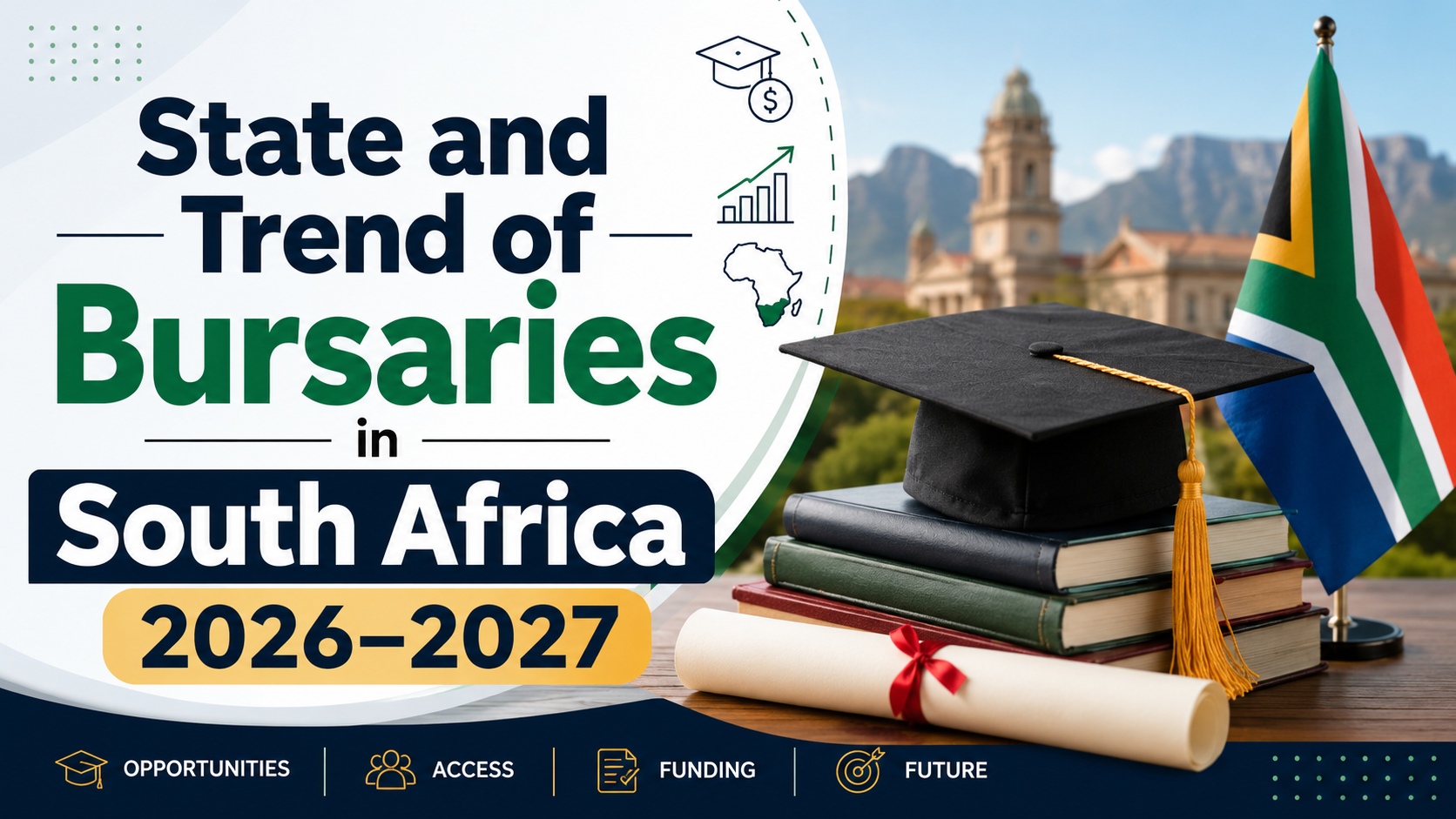
State and Trend of Bursaries. South Africa’s bursary and student-funding landscape continues to offer multiple pathways for students who need financial assistance to pursue higher education. While government funding through the National Student Financial Aid Scheme (NSFAS) remains the main route for financially eligible students at public universities and TVET colleges, students can also explore teacher-training bursaries, SETA funding, university scholarships, corporate bursaries, and foundation-funded opportunities.

For students planning their studies in 2026 and 2027, understanding how these different funding channels work can make it easier to identify suitable opportunities and prepare applications on time.
1. NSFAS: The Government’s Main Bursary Route
The National Student Financial Aid Scheme (NSFAS) remains one of the most important sources of financial support for students from poor and working-class households.
According to NSFAS eligibility rules, the bursary is generally available to qualifying students whose combined household income is up to R350,000 per year. For persons with disabilities, the household-income threshold can extend to R600,000 per year, subject to NSFAS requirements, verification, and other eligibility conditions.
NSFAS support is available to eligible students studying at public universities and public TVET colleges.


NSFAS Student Loan Option
Students whose household income is above the bursary threshold may also have another option through the NSFAS student-loan stream.

The NSFAS student-loan route is aimed at applicants with a combined household income above R350,000 but not exceeding R600,000 per year. The exact structure and conditions depend on the applicable NSFAS rules.
This means students should not automatically assume that they are excluded from financial assistance simply because their household income is above the bursary threshold. Checking both available NSFAS funding routes can be important.
2026 NSFAS Applications and Results
For the 2026 academic year, NSFAS communicated application results through the myNSFAS system. Results began being communicated from 15 December 2025, and NSFAS later indicated in a January 2026 media statement that funding decisions for 2026 applications had been concluded.
Applicants should therefore regularly check their myNSFAS profiles for application outcomes, requests for additional information, and other important notifications.
If NSFAS identifies missing or outstanding information, applicants may be required to submit the requested documents within the specified timeframe. Students should carefully follow the instructions displayed on their accounts rather than relying on information from unofficial sources.
NSFAS Appeals
Students who receive an unsuccessful funding decision may have the opportunity to appeal.
NSFAS states that appeals should generally be submitted within 30 days of receiving the application result through the student’s myNSFAS profile. Applicants should provide the supporting information or documentation requested for their particular appeal.
Students should not wait until the final day if they need to appeal because gathering supporting documents can take time.
Where NSFAS Funding Is Available
NSFAS provides financial support across South Africa’s public higher-education system. Its institutional directory covers 26 universities and 50 TVET colleges.
Students should use the official NSFAS institution information when confirming whether their chosen public institution falls within the NSFAS funding network.
2. Funza Lushaka: A Key Bursary for Future Teachers
Students interested in becoming teachers can consider the Funza Lushaka Bursary Programme, which is administered through the Department of Basic Education.
The programme focuses on supporting teacher education in priority areas. Successful beneficiaries are expected to meet the programme’s academic and other requirements and, under the applicable conditions, may have a service obligation connected with teaching in public schools after completing their qualification.
Important Funza Lushaka 2026 Rules
The 2026 application information includes several important requirements and exclusions. Applications are submitted online, meaning applicants do not need to submit hard-copy applications.
First-time applicants must meet the published eligibility requirements, including applicable age and academic criteria. Students should also carefully review the qualification exclusions before applying.
One important point in the 2026 application information is that PGCE is not funded for the 2026 cycle, along with certain other qualification types.
Because Funza Lushaka requirements can change between application cycles, prospective applicants should always review the latest official programme information before submitting an application.
Looking Ahead to 2027
Students interested in Funza Lushaka funding for 2027 should monitor official programme and Department of Basic Education announcements. Application dates, qualifying programmes, and other requirements should be confirmed once the official 2027 information is published.
3. SETA Funding and Sector-Based Opportunities
Another important part of South Africa’s student-funding ecosystem comes from the Sector Education and Training Authorities (SETAs).
SETAs use discretionary grants to support skills development within specific industries. Depending on the sector and funding programme, opportunities can include bursaries, higher-education funding, learnerships, and other forms of training support.
Unlike NSFAS, SETA opportunities are often announced through specific funding windows with defined opening and closing dates.
Examples of SETA Funding Windows
Several SETAs have published funding opportunities connected with the 2026/2027 financial year.
For example, CHIETA published a 2026/2027 Cycle 1 discretionary-grant opportunity with specific application dates and a training period aligned with April 2026 to March 2027.
merSETA also published a 2026/2027 discretionary-grant opportunity, with applications submitted through its relevant online system.
Meanwhile, BANKSETA published a Higher Education Funding Window for 2026, including application guidance and an online application process.
These examples demonstrate why students should monitor the SETA that operates within their particular industry or field of study.
Planning for 2027 SETA Funding
SETA funding opportunities do not necessarily follow one universal application calendar. Each SETA can establish its own requirements, funding categories, and deadlines.
Students planning for 2027 should therefore identify the SETA relevant to their field and regularly check its official website for newly announced funding windows.
4. University-Administered Bursaries and Scholarships
Government funding is not the only option available to South African students.
Many universities administer their own bursaries, scholarships, and financial-aid programmes. These may be based on academic merit, financial need, sporting achievement, leadership, specific study fields, or other criteria.
The application process varies from one institution to another. Some opportunities may require students to apply directly through the university’s financial-aid office, while others may have separate online application systems.
Students should check their university’s official financial-aid or bursary pages regularly and take note of application deadlines.
5. Corporate and Foundation Bursaries
Companies, charitable foundations, and other private organisations also contribute significantly to South Africa’s bursary landscape.
Corporate bursaries can be particularly valuable because many are designed around specific skills shortages or industries. A company may, for example, support students studying engineering, finance, information technology, accounting, mining, education, or other fields relevant to its workforce needs.
Eligibility requirements vary widely. Applicants may need to provide academic records, proof of household income, identification documents, admission letters, proof of registration, or other supporting documents.
Some corporate bursaries may also include employment opportunities after graduation, while others can include work-back or service obligations.
StudyTrust and Seasonal Bursary Applications
StudyTrust is another useful pathway for students searching for multiple bursary opportunities.
StudyTrust states that its bursary applications generally open on 1 May and, in most cases, close on 30 September. Some programmes may have work-back obligations, meaning beneficiaries can be expected to work for the sponsoring organisation after completing their studies.
One online application can be considered for multiple bursaries or scholarships within the StudyTrust portfolio, subject to the individual requirements of each programme.
Students interested in funding for the 2027 academic year should begin monitoring these opportunities well before application deadlines.
What Is Changing in South Africa’s Bursary Landscape?
The South African bursary environment is becoming increasingly diversified. Students are no longer limited to a single funding route.
NSFAS continues to provide the government-backed foundation for eligible students, while the student-loan stream creates an additional pathway for some households above the bursary income threshold. At the same time, programmes such as Funza Lushaka focus on national skills priorities, while SETAs target industry-specific skills development.
Universities, companies, and foundations add another layer of funding opportunities.
This multi-channel environment means students can improve their chances of receiving financial assistance by applying to several suitable programmes instead of depending entirely on one application.
Practical Tips for Students Applying for Bursaries
Students preparing applications for 2026 or 2027 should consider the following steps:
Start With Official Sources
Begin your search with official NSFAS, Funza Lushaka, university, SETA, and bursary-provider websites. This helps reduce the risk of relying on outdated deadlines or misleading information.
Prepare Documents Early
Many applications require similar documents, such as identification documents, academic results, proof of household income, admission information, and other supporting records.
Preparing these documents in advance can make the application process easier and reduce delays.
Check Your Funding Route
For NSFAS applicants, understand the difference between bursary and student-loan eligibility. Household income is an important part of determining which route may apply.
Monitor Deadlines
Funding windows can close quickly. SETAs and private sponsors may have completely different application periods, so students should maintain a calendar of important dates.
Use the Appeal Process When Appropriate
If an NSFAS application is unsuccessful and the student believes there are grounds for reconsideration, the official appeal process should be reviewed. NSFAS states that appeals must generally be submitted within 30 days of receiving the result.
Apply Through Multiple Channels
Students should not necessarily depend on a single bursary. Where eligibility allows, they can consider NSFAS, university funding, SETA opportunities, corporate bursaries, foundations, and other legitimate funding programmes.
Conclusion
The state of bursaries in South Africa continues to reflect a broad and evolving student-funding ecosystem. NSFAS remains the central government funding route, while Funza Lushaka supports students entering priority teaching fields. SETAs provide sector-specific funding opportunities, and universities, companies, foundations, and organisations such as StudyTrust provide additional pathways.
For students planning their education in 2026 and 2027, the most effective approach is to start early, understand eligibility requirements, prepare supporting documents, monitor official announcements, and consider more than one funding channel.