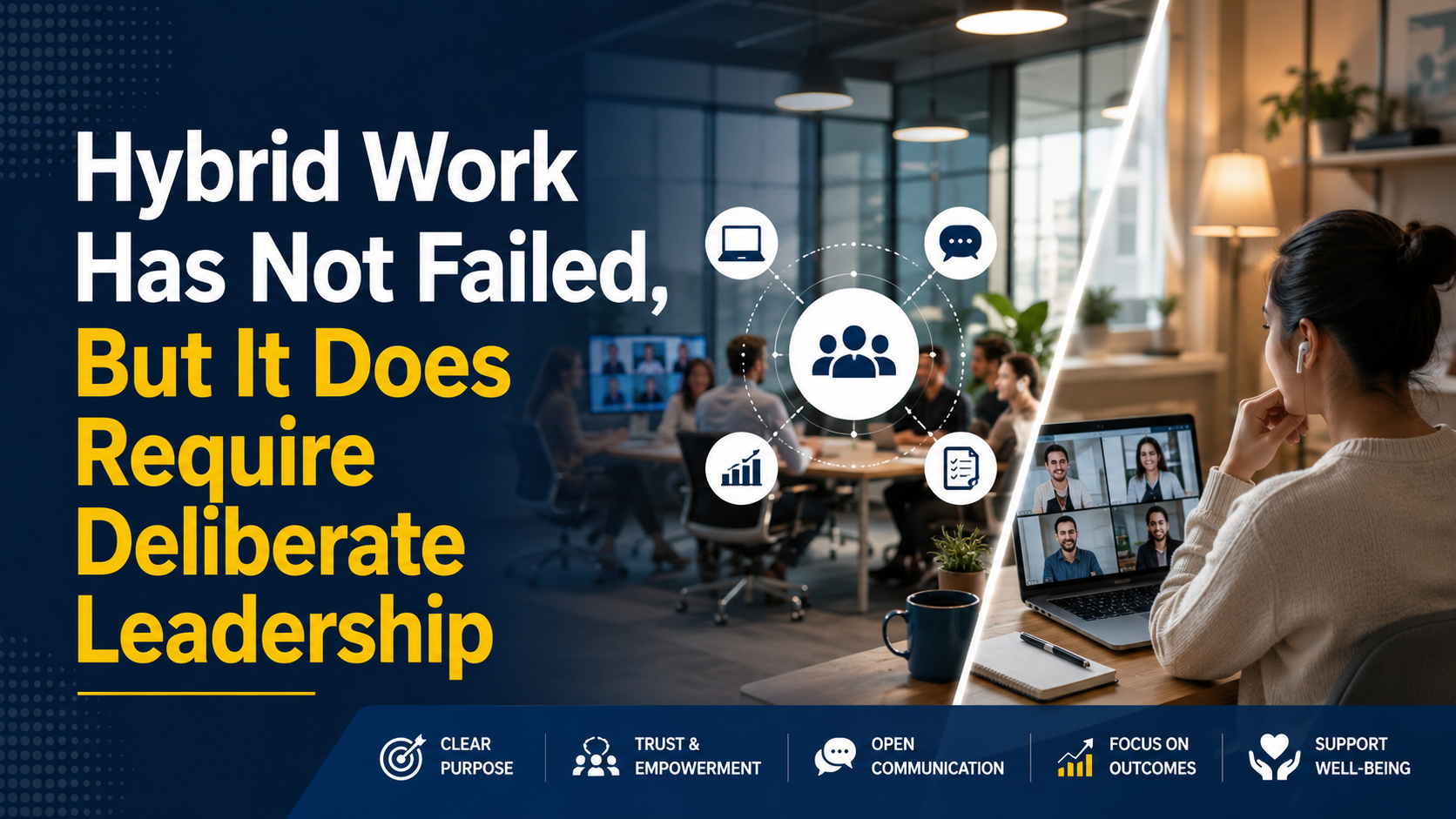
Hybrid Work Has Not Failed, But It Does Require. Hybrid work has become one of the most significant changes in the modern workplace. When the COVID-19 pandemic forced offices to close in 2020, remote work was introduced largely as an emergency solution. Employees quickly transformed kitchen tables into workstations, meetings moved online, and companies adopted digital tools to keep operations running.

More than six years later, flexible and hybrid working models have become a permanent part of the employment landscape. However, businesses continue to debate whether employees should work remotely, return to the office full-time, or follow a combination of both approaches.
Some major companies have increased their office requirements. Amazon introduced a five-day office expectation in January 2025, while companies such as JPMorgan Chase and Dell have also moved toward greater office attendance. Google, meanwhile, has continued to support a more flexible approach with employees generally expected to spend three days a week in the office.
These different approaches raise an important question: Has hybrid work failed, or does it simply require better leadership?
According to Helen Bredenkamp, Group Head of People and Culture at The Unlimited, the effectiveness of hybrid work depends heavily on how the model is managed. Without clear leadership, communication can become fragmented, employees may feel disconnected, and managers may struggle to evaluate performance.


However, these challenges do not necessarily mean that hybrid work itself has failed. Instead, they may indicate that organizations have not created the right systems and expectations to support distributed teams.

When properly managed, hybrid work can benefit both employees and businesses. Employees receive greater flexibility and autonomy, while companies can maintain accountability, productivity, collaboration, and workplace connection.
Here are five important strategies businesses can use to make hybrid work successful.
1. Establish a Clear Purpose
Hybrid work should not be introduced simply because it is popular. Organizations need to understand why they are adopting a flexible working model.
Possible reasons include accessing a wider talent pool, attracting specialist skills, improving employee satisfaction, increasing retention, or supporting work that can be performed effectively from different locations.
A clear purpose also allows management to evaluate whether hybrid working is achieving its intended results.
For example, The Unlimited has used hybrid work to retain specialist employees and institutional knowledge even when employees relocate to other regions or countries. It has also enabled the company to access talent from different parts of South Africa without requiring employees to move.
2. Measure Results Instead of Office Presence
One of the biggest challenges of hybrid work is avoiding the assumption that employees who spend more time in the office are automatically more productive.
Effective hybrid organizations should focus on outcomes rather than visibility.
Employees should understand their responsibilities, deadlines, performance expectations, and business objectives. Managers should measure the quality and results of completed work rather than simply counting how many hours someone spends in an office.
At The Unlimited, employees establish major annual goals that are measured against agreed outcomes. Scrum practices and regular performance reviews are also used to maintain focus and accountability.
This approach helps organizations build a culture where performance is based on impact rather than physical presence.
3. Make Communication Intentional
In a traditional office, employees can exchange information through informal conversations, quick meetings, and casual interactions. These opportunities can disappear when teams work remotely.
For this reason, hybrid organizations need deliberate communication systems.
Regular team meetings, individual check-ins, company updates, collaborative platforms, and opportunities for employee feedback can help maintain alignment.
The Unlimited, for example, holds a company-wide meeting called “Engage” every other Friday. The meeting provides an opportunity to share business updates, discuss goals, reinforce company values, recognize employees, and create space for feedback.
Such regular interactions can help employees remain connected to the wider organization even when they are not physically together every day.
4. Use Cloud Technology Responsibly
Cloud technology has played a major role in making hybrid work possible. Employees can access files, applications, communication platforms, and business systems from different locations.
However, greater digital connectivity also creates cybersecurity challenges.
Companies need appropriate security systems, employee training, access controls, and awareness programs to protect business and customer information.
Cybersecurity should not be treated as the responsibility of the IT department alone. Employees also play an important role by following security procedures, protecting passwords, recognizing suspicious messages, and handling company information responsibly.
5. Make Office Days Meaningful
If employees are required to travel to an office only to spend the entire day attending virtual meetings, the purpose of office attendance becomes questionable.
Instead, organizations should make in-person days valuable.
Office days can be used for activities that benefit from face-to-face interaction, including brainstorming, strategic planning, team building, training, relationship development, and solving complex problems.
The goal should not simply be to increase the number of people physically present. The goal should be to make that presence productive and meaningful.
Shared experiences can also strengthen company culture. The Unlimited’s “Love Days,” for example, provide employees with opportunities to work together while contributing to communities.
Future of Hybrid Work
Hybrid work is unlikely to disappear simply because some companies are increasing office requirements. Instead, the workplace is likely to continue experimenting with different combinations of remote and in-person work.
The most successful approach may vary from one organization to another. Some roles require regular physical presence, while others can be performed effectively from almost anywhere.
The key issue is therefore not whether hybrid work is inherently good or bad. The more important question is whether the organization has created the leadership, communication, technology, accountability, and culture required to make the model work.
Conclusion
Hybrid work has not necessarily failed. Rather, it has demonstrated that flexibility requires deliberate management.
Clear expectations, outcome-based performance measurement, intentional communication, secure technology, and purposeful office days can help organizations achieve a balance between flexibility and accountability.